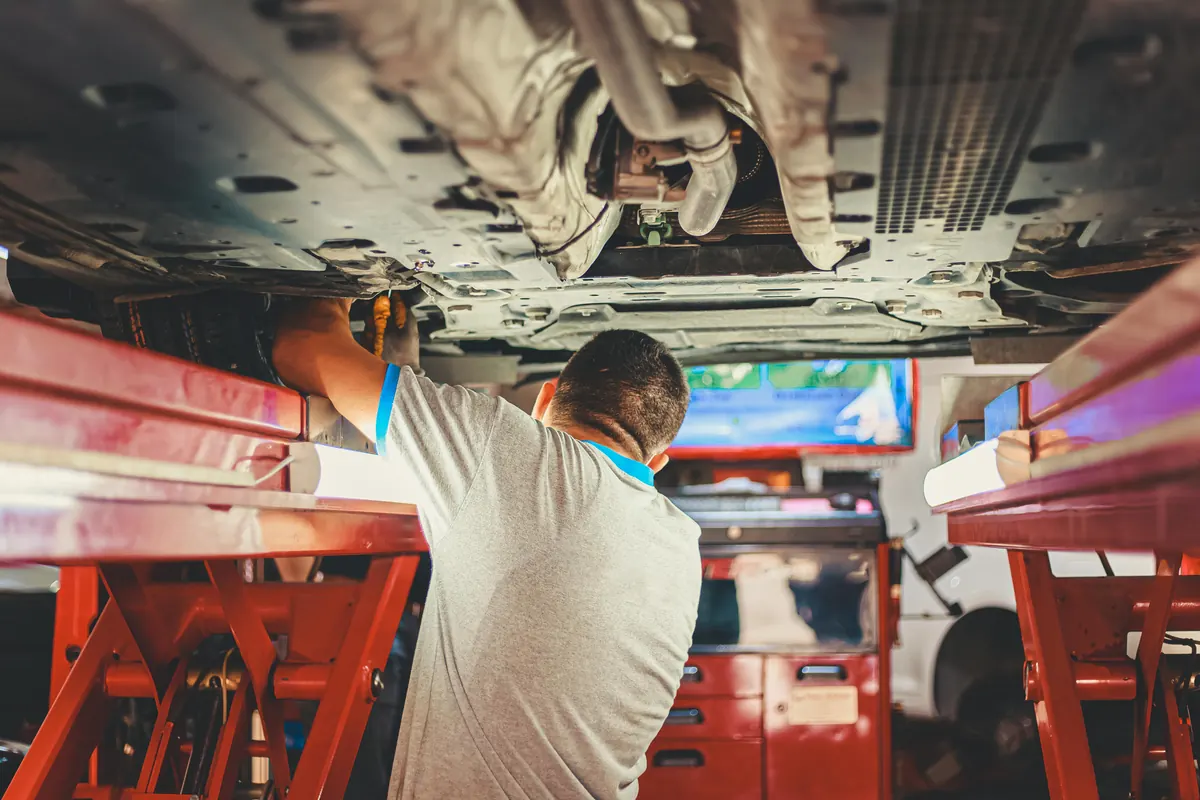
Northern Ireland operates a completely separate vehicle testing system from the rest of the UK. The DVA (Driver and Vehicle Agency) runs all MOT tests through government-owned centres, the first test falls at four years rather than three, and a range of NI-specific rules govern everything from historic vehicle exemptions to cross-border enforcement at the Irish border. This guide covers every aspect of the NI MOT system in detail.
DVA vs DVSA: Two Separate Systems
In Great Britain, MOT testing is carried out by private garages authorised by the DVSA (Driver and Vehicle Standards Agency). Any DVSA-approved mechanic at an approved garage can conduct tests. There are approximately 23,000 MOT test stations in GB, ranging from large franchise dealerships to single-bay independent garages.
In Northern Ireland, testing is carried out at government-owned test centres run by the DVA (Driver and Vehicle Agency), a devolved agency within the Northern Ireland Executive operating under the Department for Infrastructure. All DVA testers are government employees. There are no private MOT test stations in Northern Ireland at all.
The administrative separation runs deep. The DVA maintains its own vehicle testing database, its own testing standards, and its own network of purpose-built facilities. Policy changes made by Westminster to the GB MOT scheme do not automatically apply in NI. When the DVSA introduced revised defect categories in 2018, NI adopted the same categories as a deliberate policy decision, not automatically. The DVA and DVSA share data through infrastructure feeding into the DVLA's central register, which is why a DVA MOT is recognised when renewing road tax online.
NI Number Plate Formats Explained
Understanding NI registration plates is important when using any online MOT checker. Modern NI plates issued since September 1999 follow the same format as the rest of the UK: two letters, two digits, a space, then three letters (for example AB12 CDE). These plates are visually indistinguishable from GB plates.
Older NI plates used before the current format carried a three-letter county identifier followed by a number sequence. Examples include ABZ 1234 (Belfast), OI 1234, or RUI 123. These older plates remain legal and still appear on older vehicles on NI roads. The three-letter prefix identified the county of original registration.
| Format Type | Example | Period | Notes |
|---|---|---|---|
| Old NI county format | ABZ 1234 | Pre-1999 | Three-letter county code plus number. Unique to NI. |
| Old NI two-letter format | OI 1234 | Pre-1999 | Two-letter code used in some NI areas. Still valid. |
| Current UK format (NI issued) | AB12 CDE | September 1999 onwards | Same visual format as GB but NI-registered. |
| GB current format | AB12 CDE | September 2001 onwards | GB regional code plus age identifier plus random letters. |
When checking MOT status online, enter the registration exactly as shown on the plate without spaces. The DVSA/DVA data systems accept all valid UK registration formats including older NI-style plates.
When Is the First MOT Due in NI?
This is the most practically important difference for everyday vehicle owners. In England, Scotland and Wales, the first MOT falls on the third anniversary of the vehicle's first registration. In Northern Ireland, the first test is due on the fourth anniversary. Every subsequent test is annual in both jurisdictions.
The one-year extension applies only to the initial test. It does not carry forward. Once a vehicle has had its first NI DVA test at four years, the annual cycle begins and the certificate lasts 12 months from the test date, exactly as in GB.
If you buy a car that was first registered in Northern Ireland but later re-registered in GB, the GB three-year rule applies from the point of GB registration. A vehicle that was registered in NI in 2022 with no MOT history is not necessarily suspicious: it may simply be within its four-year exemption window. Always verify the registration date before drawing conclusions from the absence of MOT records.
DVA Test Centres: Locations and Booking
The DVA operates a network of purpose-built test centres covering all parts of Northern Ireland. Unlike the GB system where thousands of private garages offer MOT slots, NI drivers must travel to one of a limited number of government facilities. Slot availability is more constrained than in GB, making advance planning more important.
| Test Centre | Area Served | Vehicle Classes Available |
|---|---|---|
| Boucher Road, Belfast | Greater Belfast | Cars, motorcycles, light goods |
| Duncrue Street, Belfast | Greater Belfast North | Cars, HGV, buses, motorcycles |
| Derry/Londonderry | North West NI | Cars, motorcycles, light goods |
| Coleraine | North Coast | Cars, motorcycles, light goods |
| Ballymena | Mid-Antrim | Cars, motorcycles, light goods |
| Newtownabbey | North Belfast suburbs | Cars, motorcycles |
| Lisburn | South Belfast suburbs | Cars, motorcycles, light goods |
| Newry | South Down and Armagh | Cars, motorcycles, HGV |
| Enniskillen | Fermanagh | Cars, motorcycles, light goods |
| Omagh | Tyrone | Cars, motorcycles, light goods |
How to Book a DVA MOT: Step by Step
All DVA bookings must be made in advance. There are no walk-in tests. The primary booking route is online via nidirect.gov.uk, which is the Northern Ireland government's public services portal. Telephone booking is also available for those who prefer not to book online.
- Go to nidirect.gov.uk and navigate to the DVA vehicle testing section or search "book a vehicle test".
- Enter your vehicle registration number. The system will look up the vehicle details and confirm eligibility for the test class required.
- Select the test type: standard Class 4 car, motorcycle, light goods, or other applicable class.
- Choose a test centre from the available locations. You may select any DVA centre in Northern Ireland regardless of where you live.
- Select a date and time slot from available appointments. Slots update in real time.
- Provide your contact details and receive a confirmation email or text with your appointment reference.
- Pay the test fee online. Payment is required at the time of booking for most test types.
- Attend the centre at least ten minutes before your booked time. Late arrivals may forfeit their slot and the fee.
Cancellations made less than three working days before the test may not receive a fee refund. Check the current cancellation terms on nidirect.gov.uk before booking. If you cannot get a slot at your nearest centre in time, the booking system allows you to search all DVA locations simultaneously.
DVA Test Content vs DVSA Test Content
The items inspected during a Northern Ireland DVA test and a Great Britain DVSA test are drawn from the same legislative framework. Both systems are underpinned by the Road Vehicles (Construction and Use) Regulations and equivalent EC Directives on periodic technical inspection. The practical result is that the checklist of items is almost identical.
Both tests inspect brakes (including parking brake), lighting and signalling, steering, suspension and wheel bearings, tyres and wheels, seatbelts and restraints, fuel system integrity, exhaust emissions, wipers and washers, horn, mirrors, and body structure. The DVA test additionally standardises underbody corrosion assessment across all centres using vehicle lifts, which is relevant given NI's wetter climate and the age profile of the NI vehicle fleet.
The key administrative difference is the delivery environment. In GB, testers are often mechanics at local garages working between repairs. In NI, all testers are dedicated DVA government employees working in standardised lanes with centrally maintained equipment. This produces a more consistent test environment but does not make the pass criteria more or less demanding.
| Feature | NI DVA System | GB DVSA System |
|---|---|---|
| Test locations | Government DVA centres only | Any DVSA-authorised garage or test station |
| Testers | DVA government employees | Private garage technicians with DVSA approval |
| First test age | 4 years | 3 years |
| Annual frequency after first test | Every 12 months | Every 12 months |
| Defect categories | Dangerous / Major / Minor / Advisory | Dangerous / Major / Minor / Advisory |
| Certificate validity | 12 months, valid across whole UK | 12 months, valid across whole UK |
| Online booking | nidirect.gov.uk (DVA) | Individual garage booking systems |
| Fee structure | Government-set flat fee | Private garage price up to DVSA maximum |
NI Test Classes and Fees
The DVA tests vehicles across multiple classes, with fees set by the Northern Ireland Executive and reviewed periodically. Because tests are government-run with no commercial markup, the actual cost to the motorist is more predictable than in GB where garages set their own prices up to the DVSA maximum.
- Class 1 and 2: motorcycles up to 200cc and above 200cc respectively
- Class 4: private passenger vehicles with up to 8 passenger seats (the standard car test)
- Class 5: private passenger vehicles with more than 8 seats (minibuses and larger)
- Class 7: goods vehicles with a design gross weight not exceeding 3,500 kg
- Heavy goods vehicles and buses: tested at specialist DVA lanes at Belfast Duncrue Street, Newry, and Derry
- Adapted vehicles: tested under standard class rules with additional checks for adaptation equipment
The standard Class 4 car test fee at DVA centres is set at around £37.50, substantially lower than the DVSA maximum of £54.85 in GB. Retest fees are reduced if the vehicle returns to the same centre within the permitted window (typically within 21 working days) and only the failed items are retested. Check nidirect.gov.uk for current fee schedules as these are subject to periodic revision.
The NI MOT Certificate
When a vehicle passes a DVA test, the owner receives a DVA test certificate. The physical format is similar to the DVSA certificate issued in GB and contains the same key information: vehicle registration, make, model, test date, expiry date, odometer reading, and tester identification. The certificate carries DVA branding and references Northern Ireland legislation rather than GB legislation.
The certificate is printed at the DVA centre and handed to the vehicle owner at the conclusion of the test. Digital records are held in the DVA database and are accessible through the DVSA national MOT data system used by our checker. The certificate number format uses a DVA-specific prefix but this does not affect its legal status anywhere in the UK.
A DVA certificate is legally equivalent to a DVSA certificate throughout the United Kingdom. Police, insurers, and other authorities in England, Scotland and Wales must accept a valid NI DVA certificate without question. Similarly, a GB-issued DVSA certificate is valid in Northern Ireland. The certificates are interchangeable for all practical and legal purposes.
NI Test Result Categories
Following the alignment of defect categories across the UK in 2018, NI test results use the same four-category classification as GB. This replaced the older simple pass/fail model with a graduated framework that gives owners clearer information about the severity of any problems found.
- Pass: No defects found, or only advisory items noted. Certificate issued immediately.
- Pass with Advisories: The vehicle passes but has items approaching failure standard, noted on the certificate for the owner's attention.
- Major defect: Faults that affect safety or the environment and must be rectified before the vehicle can be certified. The vehicle fails the test.
- Dangerous defect: An immediate risk to road safety or the environment. The vehicle fails and must not be driven away from the test centre.
NI Retest Rules
When a vehicle fails a DVA MOT, the retest process in Northern Ireland works as follows. If the vehicle is returned to the same DVA test centre within the specified window (typically within 21 working days of the original test date) and only the items that originally failed are being retested, a reduced-fee partial retest applies. New faults found during a partial retest are recorded and may cause a further failure.
If you take your vehicle to a different DVA test centre for the retest, the full test fee is charged and the vehicle undergoes a complete new inspection. There is no partial retest discount available when switching centres. For convenience and cost, always return to the original centre within the free or reduced-fee retest window unless that centre is genuinely impractical.
DVA centres do not carry out repairs themselves. After a failure, you must take the vehicle to a garage of your choice, have the required work done, and return to the DVA centre for the retest. Keep all receipts and evidence of repairs, as the tester will verify that the failed items have been addressed.
NI Test Pass Rate Statistics
DVA published data shows that Northern Ireland vehicles have a first-attempt pass rate somewhat lower than the GB average. The overall NI first-attempt pass rate for Class 4 cars has historically sat in the range of 55 to 62 percent, compared with a GB average of around 57 to 65 percent depending on the year and vehicle cohort. Urban centres such as Belfast and Newtownabbey generally see higher pass rates because the vehicle fleet is newer. Rural centres such as Omagh, Enniskillen, and Newry test proportionally more older vehicles and see lower first-attempt pass rates.
The most common failure categories in NI mirror the UK-wide picture: lighting faults (approximately 15 to 18 percent of all failures), tyres (12 to 14 percent), brakes (10 to 12 percent), suspension and steering (9 to 11 percent), and bodywork corrosion. Corrosion failures are proportionally more common in NI than in most GB regions because Northern Ireland's wetter climate accelerates rust, particularly on brake discs, suspension joints, sills, and floor pans. Vehicles that spend their life on rural roads in counties Fermanagh, Tyrone, or Down show disproportionately high rates of structure-related failures.
DVA statistics are published annually in the DfI annual report and via the Northern Ireland Statistics and Research Agency (NISRA). These figures cover all vehicle classes and include breakdowns by test centre, vehicle type, and failure category.
NI Advisories System
The advisory system in Northern Ireland works identically to the GB advisory system. When a DVA tester identifies an item that is not yet at failure standard but is deteriorating and will likely fail at a future test, they record it as an advisory note on the certificate. Advisories do not cause a test failure and the vehicle receives a pass certificate.
Common NI advisories include tyre wear approaching the 1.6mm legal minimum, minor corrosion on brake discs or suspension components, worn wiper blades, minor exhaust corrosion, and minor fluid leaks not yet severe enough to constitute a failure. Brake corrosion advisories are particularly common on NI vehicles that are not used regularly, due to the damp climate.
Advisories are recorded in the DVA database and appear when you check a vehicle's MOT history online. This is valuable when buying a used vehicle: a history of repeated advisories for the same item across multiple tests indicates a deteriorating component that has been neglected rather than repaired. Use our MOT history checker to view all past test results and advisories for any NI-registered vehicle.
Acting on advisories before the next test rather than waiting for items to reach failure standard avoids the combined cost of a failed test and a retest, and avoids the scheduling challenge of finding a DVA slot at short notice. Addressing an advisory-stage tyre or suspension component is considerably cheaper than the consequences of a failure at the test centre.
NI Historic Vehicle Exemption
Vehicles manufactured more than 40 years ago are exempt from the annual MOT requirement in Northern Ireland, aligned with the GB-wide policy. The 40-year exemption is rolling, meaning it applies to any vehicle first manufactured more than 40 years before the current date, regardless of which specific calendar year that falls in.
Prior to the current unified framework, Northern Ireland had its own separate historic vehicle exemption with a different cutoff. NI previously exempted vehicles at 30 years rather than 40. When the UK government extended the GB exemption to 40 years, NI aligned with the new threshold through a deliberate policy decision rather than automatic legislative transfer. The current NI position is therefore 40 years, matching GB.
Exempt vehicles are still subject to all other road traffic law. They must be roadworthy, insured, and taxed. The MOT exemption removes the periodic test requirement but does not exempt the vehicle from enforcement if it is driven in an unsafe condition on public roads. Vehicles substantially modified from their original specification may lose their exemption status.
- Historic exemption does NOT mean the vehicle is exempt from being roadworthy.
- Historic exemption does NOT exempt the vehicle from road tax (VED).
- Historic exemption does NOT cover substantially modified vehicles that no longer reflect their original specification.
- Historic exemption does NOT protect from prosecution for driving in an unsafe condition.
SORN and VED in Northern Ireland
Vehicle Excise Duty (VED, commonly called road tax) is administered for Northern Ireland vehicles by the DVLA in Swansea, exactly as for GB vehicles. There is no separate NI road tax authority. This is one area where Northern Ireland is fully integrated with the GB system rather than operating through the DVA.
SORN (Statutory Off Road Notification) is also processed through the DVLA rather than any NI agency. SORN can be completed online via gov.uk, by post to the DVLA in Swansea, or by telephone. The DVLA handles all NI SORN declarations in the same way as GB declarations. You cannot tax an NI-registered vehicle online without a valid MOT certificate, because the DVLA checks the DVA database automatically when you apply.
VED rates for NI vehicles are identical to GB rates. The same emissions-based banding applies, the same First Year Rate and Standard Rate structure applies, and the same exemptions apply: zero-emission vehicles, vehicles first registered before January 2001 with engines under 1549cc, disabled tax class, and historic vehicles. Being in Northern Ireland does not qualify a vehicle for any special VED discount or different banding.
Moving a Vehicle Between NI and GB
Vehicles moving between Northern Ireland and Great Britain do not need to be retested simply because they have crossed the Irish Sea. A valid MOT certificate, whether issued by the DVA or the DVSA, is valid for driving anywhere in the UK until it expires. The cross-border recognition is automatic and statutory.
Moving from NI to GB
If you relocate from Northern Ireland to Great Britain with your vehicle, your DVA certificate remains valid until its expiry date. When it expires, renew through the standard GB system at any DVSA-authorised test station near your new address. You do not need to inform the DVSA of the transition or obtain any special documentation for the MOT side of the change.
You must notify the DVLA and update the V5C logbook to your new GB address. This is a legal requirement within a set timeframe of moving. Contact the DVLA at gov.uk/change-address-v5c to update your records. Failure to keep the V5C address current is an offence.
Moving from GB to NI
If you move from Great Britain to Northern Ireland with a GB-registered vehicle, your existing DVSA certificate is valid until it expires. When it expires, you must book through the DVA system at an NI test centre. If your GB vehicle is over three years old when you move to NI but has never had its first GB MOT (for example, you moved before the three-year GB deadline would have triggered), the vehicle is already overdue for a test and you should book a DVA test promptly. Do not assume the NI four-year rule applies to a GB-registered vehicle that has already passed the three-year point.
Electric Vehicle MOT in NI
Electric vehicles registered in Northern Ireland follow the same four-year initial MOT rule as all other NI vehicles, with annual DVA tests thereafter. The test content for EVs is largely the same as for conventional vehicles, with the emissions test replaced by a check confirming that the electric drivetrain functions as designed and that the high-voltage wiring is properly insulated and safe.
DVA testers receive specific training for EV testing. The test covers all standard safety items (brakes, lights, tyres, steering, structure) plus EV-specific items: high-voltage cable condition and routing, battery mounting security, regenerative braking function, and the absence of dangerous electrical faults. The tester does not deeply inspect the battery management system but assesses all visible electrical components.
A practical consideration for NI EV owners in rural areas: the relatively small number of DVA test centres means driving to and from the test centre may be a longer journey than for most GB drivers. In winter, when battery range is reduced, plan the journey to avoid range anxiety. All DVA test centres accept EVs; check whether your chosen centre has charging facilities available if range is a concern.
NI Motorcycle MOT Test
Motorcycle testing in Northern Ireland follows the same class structure as GB. Class 1 covers motorcycles up to 200cc and Class 2 covers those above 200cc. Tricycles and quadricycles are tested under separate class rules. All motorcycle tests must be conducted at a DVA test centre; there are no mobile or private motorcycle test options.
The motorcycle test in NI covers: frame and structure, wheels and tyres, steering and suspension, brakes (front and rear), lights, reflectors, horn, mirrors, exhaust, emissions, fuel system, and seatbelts or restraints where fitted. The emissions test for motorcycles is a simple exhaust gas analysis rather than the more complex procedure applied to cars.
Motorcycle test slots at DVA centres are less numerous than car slots, which can mean longer waiting times. The Boucher Road and Duncrue Street Belfast centres are the highest-capacity motorcycle testing facilities in NI. If you ride a motorcycle registered in NI, book well ahead of your certificate expiry date to avoid a gap in cover.
NI Commercial Vehicle Testing
Heavy goods vehicles (HGVs) and public service vehicles (PSVs, including buses and coaches) based in Northern Ireland are tested by the DVA at specialist test lanes equipped for larger vehicles. The specialist HGV and PSV lanes are concentrated at Belfast Duncrue Street, Newry, and Derry, with additional capacity at some other centres.
Commercial vehicle tests in NI cover all standard items plus additional checks specific to larger vehicles: tachograph installation and calibration, load securing equipment, side underrun protection, rear underrun protection, spray suppression systems, and the condition of the goods-carrying body or passenger compartment. Annual roadworthiness testing for commercial vehicles is a statutory requirement under the Road Traffic (Northern Ireland) Order 1981.
DVA enforcement officers conduct roadside checks of commercial vehicles across NI. Vehicles found to be unroadworthy can be issued prohibition notices on the spot and must not return to service until the defects are rectified and a clearance obtained. Fleet operators running commercial vehicles in NI must maintain records of all test certificates and keep vehicles in a roadworthy condition at all times.
Taxi and Private Hire Vehicle Testing in NI
Licensed taxis and private hire vehicles in Northern Ireland are subject to additional testing requirements beyond the standard annual MOT. Under the Taxis Act (Northern Ireland) 2008, all taxis must hold a valid vehicle licence issued by the DVA. To obtain and renew this licence, taxis must pass a separate DVA taxi vehicle test in addition to the standard MOT.
The taxi vehicle test is more rigorous than a standard Class 4 test and includes checks specific to fare-paying passenger use: taxi meter calibration and installation, accessible vehicle equipment where applicable, passenger compartment condition, partition screens, and the condition of all passenger controls. Private hire vehicles (booked in advance through an operator rather than hailed on the street) are also subject to DVA licensing and must undergo the taxi vehicle test.
The frequency of testing for licensed vehicles is higher than for private cars. Depending on the vehicle's age and licence conditions, a licensed taxi may be required to present for testing more than once per year. This is materially different from the GB taxi licensing system, where licensing is handled by local councils and testing requirements vary significantly between licensing authorities. In NI, the DVA provides a single, standardised testing framework for all licensed vehicles across the province.
Ambulance, Emergency and Disabled Adaptation Vehicles
Ambulances and emergency vehicles operated by the Northern Ireland Ambulance Service (NIAS), the Police Service of Northern Ireland (PSNI), and the Northern Ireland Fire and Rescue Service (NIFRS) are subject to annual roadworthiness testing through the DVA. Emergency vehicles do not receive blanket MOT exemptions simply by virtue of their operational role; they must demonstrate roadworthiness through the same annual test framework as other vehicles.
DVA testing of emergency vehicles accounts for the specialist equipment fitted: flashing lights and sirens, stretcher mounts, medical equipment securing, bull bars and protective bodywork, and high-capacity alternators. The testing lanes used are the same specialist lanes used for other large or modified vehicles at centres with the required capacity.
Vehicles modified for disabled use (hand controls, wheelchair lifts, lowered floors, hoists) are tested under standard class rules with additional checks for the integrity and correct operation of the adaptation equipment. Adaptation components must be safe, secure, and fit for purpose. The DVA works with the Department for Communities' Motability scheme in NI to ensure adapted vehicles meet the required standards.
Cross-Border Enforcement: ROI Vehicles in NI
The land border between Northern Ireland and the Republic of Ireland is the only land border in the UK, creating a unique enforcement context. Vehicles registered in the Republic of Ireland routinely cross into Northern Ireland. These vehicles are subject to UK road traffic law while on NI roads, including the requirements to be insured and roadworthy.
Republic of Ireland vehicles are required to hold a valid NCT (National Car Test) certificate to be legally on the road in Ireland. However, an NCT certificate is not equivalent to a UK MOT certificate. The NCT is operated by the National Car Testing Service (NCTS) under Irish law. A valid NCT does not satisfy the UK MOT requirement and vice versa. Each certificate is valid only within its own jurisdiction.
The DVA's vehicle enforcement teams conduct roadside checks across Northern Ireland, including in border areas. Cross-border commercial vehicle operators are a particular enforcement focus. NI-registered vehicles driving into the Republic of Ireland must comply with Irish road traffic law. A UK MOT is not recognised as an NCT equivalent in the Republic. UK vehicles spending extended periods in the Republic (generally more than 12 months) may be required to register there and obtain an NCT. Short-term visits are not affected.
NI Fleet Operators
Businesses and organisations operating fleets of vehicles in Northern Ireland must manage all MOT testing through the DVA system. This creates different logistical considerations compared with GB fleet operators who can use any number of approved private test stations near their depots. In NI, all tests must go through government centres with limited slot availability.
For large fleets, it is possible to arrange commercial booking accounts with the DVA to streamline the scheduling process. Contact the DVA's fleet and operator services team through nidirect.gov.uk for information on bulk or operator booking arrangements. Building DVA test lead times into vehicle lifecycle planning is essential: peak-period slot availability means a fleet with many vehicles coming due in the same period can face significant scheduling challenges.
For commercial vehicle fleets subject to operator licensing, the DVA in NI administers O-licences as well as vehicle testing. This means NI fleet operators deal with a single devolved agency for vehicle testing, operator licensing, and enforcement, contrasting with the GB model where DVSA handles testing and enforcement while the Traffic Commissioners (separate bodies) handle operator licensing. The consolidated NI model simplifies compliance management for large operators.
Driving Without MOT in NI: Penalties
The penalties for driving without a valid MOT in Northern Ireland are identical to those in Great Britain, set by UK-wide road traffic legislation. Driving a vehicle on a public road without a valid MOT is a criminal offence under the Road Traffic (Northern Ireland) Order 1995 and equivalent UK-wide provisions.
- Fixed penalty for driving without valid MOT: up to £1,000.
- Insurance invalidity: most insurance policies become void while driving without a valid MOT. Claims made while uninsured are rejected and you may be personally liable for all third-party costs.
- No valid MOT means VED cannot be renewed, making the vehicle also technically untaxed.
- Police can seize and impound an unroadworthy vehicle being driven without a valid MOT.
- The only legal exemption is driving directly to or from a pre-booked DVA test appointment, or driving directly to a garage for repairs needed to pass the test.
The PSNI has access to the DVA database through the Police National Computer and the ANPR (Automatic Number Plate Recognition) network. ANPR cameras across NI roads automatically flag vehicles with expired MOTs to patrol officers. The chance of an expired MOT going undetected for any extended period on NI's ANPR-equipped road network is low.
DVA Enforcement and Complaints
The DVA has its own vehicle enforcement team distinct from the PSNI. DVA enforcement officers are authorised to stop vehicles on public roads, inspect documentation, carry out roadside vehicle condition assessments, and issue prohibition notices to vehicles found to be unroadworthy. This function covers both private vehicles and commercial vehicles across all NI roads.
If you believe your vehicle was failed incorrectly at a DVA test centre, you have the right to appeal the result. The process begins with a formal complaint to the DVA through nidirect.gov.uk. The DVA will review test records and, if a dispute remains, an independent review of the test can be requested. If the DVA upholds your complaint, they will re-examine the vehicle free of charge and issue a corrected result if appropriate.
- Speak to the tester at the centre on the day if you believe a specific item was assessed incorrectly. The tester can explain their reasoning and re-examine the item if genuinely unclear.
- If unsatisfied, submit a formal written complaint to the DVA through nidirect.gov.uk within 28 days of the test date.
- The DVA acknowledges the complaint within five working days and investigates, reviewing the tester's records, photographs, and notes.
- If the DVA upholds your complaint, they will re-examine the vehicle free of charge and issue a corrected result if appropriate.
- If you remain unsatisfied after the DVA's response, escalate to the Northern Ireland Public Services Ombudsman (NIPSO) for an independent review of how the complaint was handled.
Checking NI MOT Status Online
You can check the current MOT status of any Northern Ireland-registered vehicle using our free checker. Enter the full registration number and the tool returns the current test status, expiry date, and test history from the official database. Results are typically updated within minutes of a test being completed at a DVA centre.
Checking a vehicle's MOT history before buying is particularly important in NI because the older average age of the NI fleet means a higher proportion of vehicles have extensive test histories, including repeated advisories, periodic failures for corrosion, and test gaps. A vehicle with multiple Dangerous defect failures or several corrosion-related Major failures in its DVA history should be inspected carefully by a qualified mechanic before purchase.
For very new NI vehicles approaching their first four-year test, the system may show no MOT on record rather than an expired one, because the vehicle has never been tested. This is normal for NI vehicles under four years old and is not a warning sign. For older vehicles where the DVA record appears to start abruptly, some older NI test data predates the digital integration period and may not appear in the shared DVSA API; contact the DVA directly for the full historical record in such cases.
Official Government Resources
The following official UK government sources provide authoritative information relevant to this topic:
NIDirect is the official gateway for all DVA services in Northern Ireland — bookmark it for vehicle tax, MOT, and licensing queries.
Frequently Asked Questions
Is the NI MOT the same as a GB MOT?
Can I get my car MOT'd at a garage in Northern Ireland?
When is my first MOT due in Northern Ireland?
Is a Northern Ireland MOT certificate valid in England?
How do I book an MOT in Northern Ireland?
Can I check a Northern Ireland vehicle's MOT status online?
Does NI road tax work differently?
What if I move from NI to GB with my car?
What if I move from GB to NI with my car?
Is an ROI NCT certificate accepted as an MOT in Northern Ireland?
Are historic vehicles exempt from the MOT in NI?
What happens if my vehicle gets a Dangerous defect at a DVA test?
How do taxi vehicles in NI differ from private cars for MOT purposes?
Planning a Car Purchase?
For Northern Ireland registrations, our tool queries the DVA database directly and returns the same structured pass/fail history with defect categories available for Great Britain vehicles.
MOT Check vs HPI: Full ComparisonRelated MOT Guides
What Is an MOT Test? Complete UK Guide (2026)
An MOT is an annual safety inspection required for all UK vehicles over three years old. It checks…
How Long Does an MOT Last? Certificate Duration Explained
An MOT certificate lasts exactly 12 months from the test date. You can renew up to one calendar…
Top 10 MOT Failure Reasons in the UK (2026 Data)
The most common MOT failure reasons are lighting faults (around 18% of failures), followed by…