MOT Checker Northern Ireland — Free NI MOT Status Check
Vehicle owners in Northern Ireland need to know that the MOT system there is different from England, Scotland, and Wales. Northern Ireland's MOT testing is run by the Driver and Vehicle Agency (DVA), a devolved agency that operates its own network of test centres. Understanding the differences — and knowing how to check your NI MOT status — is essential for NI drivers.
Checking DVSA records…
DVA vs DVSA: Two Completely Separate MOT Systems
The most important thing to understand about Northern Ireland's MOT system is that it has nothing to do with the DVSA (Driver and Vehicle Standards Agency) that runs testing in England, Scotland, and Wales. In Northern Ireland, all vehicle testing is handled by the DVA (Driver and Vehicle Agency), a separate government body that answers to the Northern Ireland Executive rather than to Westminster. The DVA has its own legislation, its own test centres, its own fee structure, and its own database of test records.
This distinction matters enormously for anyone checking vehicle records online. When you enter a Northern Ireland registration plate into an online checker that queries only the DVSA database, you will typically receive a "no record found" result. This is not because the vehicle lacks an MOT. It is because the NI vehicle's test history sits in a completely separate DVA system that DVSA-based tools cannot access. Knowing which database holds the information you need is the first step to getting an accurate result.
The DVA was established following the devolution of certain transport functions to Northern Ireland. It covers not only vehicle testing but also driver licensing in NI, theory and practical driving tests, taxi and bus operator licensing, and vehicle registration within the province. This breadth of responsibility means the DVA is a more integrated transport authority than the DVSA, which focuses more narrowly on vehicle and driver standards in GB.
Northern Ireland Registration Plates: How to Recognise an NI Vehicle
Northern Ireland uses a distinct vehicle registration format that differs from the current GB system. While GB uses the two-letter local memory tag plus two-digit year identifier plus three-letter sequence format (for example AB12 CDE), Northern Ireland still uses the older three-letter, four-number format introduced decades ago. A typical NI plate looks like AXZ 1234, where the first letter is always A, B, C, D, E, F, G, I, J, or Z (reflecting historical NI area codes), followed by two further letters, then a space, and four digits.
The area identifier letters for Northern Ireland include well-known combinations. The letter Z in the first or second position is a strong indicator of an NI-registered vehicle, since Z was not used in the old GB county letter system. Plates beginning with I are also exclusively NI, as I was reserved for the island of Ireland and not used in the old GB system. Common NI prefixes include AXI, BXI, CXI, DXI, EXI, FXI, GXI, HIL, ILL, IW, JI, and many others depending on the issuing office.
When you are buying a used car and encounter a plate in the ABZ 1234 style, you are looking at a Northern Ireland vehicle. This means you need to use DVA records rather than DVSA records to check its MOT history. It also means the vehicle's first MOT was due at four years rather than three, so a vehicle that looks too new to need an MOT might actually be overdue if it has spent its life in NI under the older age threshold rules.
DVA Test Centres: Where to Get an MOT in Northern Ireland
Unlike Great Britain, where there are thousands of DVSA-authorised garages and test stations spread across every town, Northern Ireland's MOT testing is conducted exclusively at a small number of government-run DVA test centres. There are no private MOT stations in Northern Ireland. Every car, van, motorcycle, and commercial vehicle that needs an NI MOT must attend one of the DVA's own facilities. This centralised model has the advantage of consistent standards and trained government testers, but it does mean appointment slots can be in demand at busy periods.
The DVA operates test centres at the following locations across Northern Ireland. Belfast has a large centre at Boucher Road in south Belfast, which handles the highest volume of tests given the city's population. Derry (also referred to as Londonderry) has a centre serving the north-west. Newtownabbey serves the greater Belfast area to the north. Lisburn covers the south Belfast commuter corridor. Coleraine handles the north Antrim coast area. Enniskillen covers Fermanagh and the west. Newry serves the south Down and south Armagh areas near the border. Omagh covers the Tyrone heartland and mid-Ulster.
Some larger vehicles, including heavy goods vehicles and buses, may need to attend specialist testing facilities or mobile testing units. The DVA also manages authorised test facilities (ATFs) for commercial vehicles, which are explained in more detail in the commercial vehicle section below. For standard private cars and motorcycles, the eight main centres listed above handle all bookings.
| DVA Test Centre | Area Served | Vehicle Types |
|---|---|---|
| Belfast (Boucher Road) | Greater Belfast, east Antrim | Cars, motorcycles, vans, taxis |
| Newtownabbey | North Belfast, Antrim, Carrickfergus | Cars, motorcycles, vans, commercial |
| Lisburn | South Belfast, Lisburn, Dromore | Cars, motorcycles, vans |
| Derry / Londonderry | North-west NI, Strabane | Cars, motorcycles, vans, commercial |
| Coleraine | North Antrim, Ballymena, Ballymoney | Cars, motorcycles, vans |
| Enniskillen | Fermanagh, west Tyrone | Cars, motorcycles, vans |
| Newry | South Down, South Armagh, Armagh city | Cars, motorcycles, vans, commercial |
| Omagh | Mid-Ulster, Tyrone, east Fermanagh | Cars, motorcycles, vans |
How to Book an NI MOT: Step-by-Step Process
Booking an MOT in Northern Ireland is straightforward, but the process is entirely separate from the GB booking systems used by private garages. You cannot book through a garage website, a third-party booking platform, or any system associated with the DVSA. All NI MOT appointments must go through the DVA directly, either via its website on nidirect.gov.uk or by calling the DVA booking line.
- Visit nidirect.gov.uk and search for "book an MOT" or navigate to the DVA vehicle testing section. Alternatively, call the DVA customer contact centre on 0300 200 7861 during office hours.
- Have your vehicle registration number ready. You will also need your V5C logbook reference number or your previous MOT certificate number to confirm the vehicle details.
- Choose your preferred test centre from the eight locations listed above. Select a date and time that suits you. Peak morning slots fill up quickly, so booking several weeks in advance is advisable especially for popular Belfast and Newtownabbey centres.
- Confirm the vehicle class you are booking for: class 1 or 2 for motorcycles, class 3 for three-wheelers, class 4 for cars and light vans up to 3,000 kg, class 5 for larger passenger vehicles, class 7 for goods vehicles up to 3,500 kg.
- Pay the MOT fee online at the time of booking or over the phone. The DVA accepts debit and credit cards. Ensure you receive a booking confirmation number and note your appointment time.
- Arrive at the test centre at least 10 minutes before your appointment. The DVA operates a strict appointment system and late arrivals may lose their slot without a refund.
- Hand over your vehicle keys to the tester. You will usually be directed to a waiting area. The test typically takes 45 to 60 minutes for a standard car.
- Receive your test result. If the vehicle passes, you receive a DVA MOT certificate valid for 12 months. If it fails, you receive a full list of failure items and advisory notes.
NI MOT Costs and Fees in 2026
The DVA sets its own fee schedule for Northern Ireland MOT tests, and these differ from the maximum fees permitted in Great Britain under DVSA rules. In GB, the maximum MOT fee for a class 4 vehicle (standard car) is set by the government and garages may charge less. In NI, the DVA charges a fixed government fee with no scope for variation. Understanding the NI fee structure helps you budget accurately and avoids surprises at the test centre.
| Vehicle Class | Description | NI DVA Fee (2026) | GB Max Fee |
|---|---|---|---|
| Class 1 | Motorcycles up to 200cc | £15.50 | £29.65 |
| Class 2 | Motorcycles over 200cc | £29.65 | £29.65 |
| Class 3 | Three-wheeled vehicles | £37.80 | £37.80 |
| Class 4 | Cars and light vans to 3,000 kg | £54.85 | £54.85 |
| Class 5 | Minibuses and larger passenger vehicles | £59.55 | £59.55 |
| Class 7 | Goods vehicles 3,001-3,500 kg | £58.60 | £58.60 |
Retest fees in Northern Ireland differ from the initial test fees. If your vehicle fails and you bring it back to the same DVA test centre within a set period, a partial retest fee applies rather than the full fee. The retest must normally be within 14 working days and must be booked at the same centre where the failure occurred. If you miss the retest window or want to test at a different centre, you pay the full fee again.
What the NI MOT Test Covers: Full Inspection Checklist
The technical content of the Northern Ireland MOT test broadly mirrors the GB test, covering the same major vehicle systems. Both the DVA and DVSA align to European Directive 2014/45/EU on periodic roadworthiness testing, which sets minimum inspection requirements across EU member states and was retained in UK law after Brexit. However, there are some procedural and categorical differences that NI drivers should be aware of.
The DVA MOT test examines the following systems on every class 4 vehicle. Lights are checked for correct operation, beam alignment, condition of lenses, and functioning of indicators, brake lights, reversing lights, and hazard lights. Brakes are tested using a brake performance roller rig that measures braking efficiency at each wheel. Steering and suspension components are inspected for wear, play, and security. Tyres are checked for minimum legal tread depth of 1.6 mm across the central three-quarters of the tread, sidewall condition, and correct fitment. The body and structure are examined for sharp edges, corrosion affecting structural integrity, and secure attachment of panels.
Emissions testing in NI follows the same standards as GB for both petrol and diesel vehicles. Petrol vehicles are tested for carbon monoxide (CO) and hydrocarbon (HC) output. Diesel vehicles are tested for exhaust smoke opacity using a free-acceleration smoke meter. The exact limits depend on the vehicle's manufacture date and engine specification, with newer vehicles held to tighter standards. The DVA tester uses the same type of approved emissions testing equipment as used in GB garages.
- Headlights, sidelights, brake lights, indicators, hazard lights, reversing lights
- Brake performance on front, rear, and parking brake (roller rig test)
- Steering play, rack condition, power steering fluid and pump
- Suspension struts, shock absorbers, springs, anti-roll bar links and bushes
- Tyre tread depth (minimum 1.6 mm), tyre condition, tyre size matching
- Windscreen condition, wipers, washers, horn
- Seat belts: condition, anchorage, locking and release mechanisms
- Exhaust system integrity and emissions levels
- Fuel system for leaks
- Vehicle identification number (VIN) visibility
- Mirrors: presence, condition, adjustment
- Bodywork for sharp edges or structural corrosion
- Under-vehicle inspection for fluid leaks, exhaust condition, chassis integrity
NI MOT Failure Categories: Dangerous, Major, and Minor
In May 2018, the UK government introduced three new defect categories for MOT failures to align with EU Directive 2014/45/EU. Northern Ireland adopted the same three-category system: Dangerous, Major, and Minor. This replaced the older Pass/Fail/Advisory system. Understanding these categories is essential for NI drivers receiving a failure notice, because they determine what you can legally do next with the vehicle.
A Dangerous defect means the vehicle poses a direct and immediate risk to road safety or to the environment. A vehicle with a Dangerous defect fails its MOT and must not be driven away from the test centre. Examples of Dangerous defects include a completely non-functioning brake on one axle, a steering rack with severe play that causes unpredictable steering response, tyres with exposed ply or cord, fuel leaks near ignition sources, or a windscreen with a fracture directly in the driver's primary line of sight. Driving a vehicle with a Dangerous defect away from the test centre (other than directly to a garage for repair) is a criminal offence.
A Major defect means the vehicle has a significant fault that could endanger other road users or cause vehicle failure. A vehicle with one or more Major defects also fails its MOT and must not be driven on public roads until repaired. However, the distinction from Dangerous is that the risk, while serious, is not necessarily immediate. Examples of Major defects include a single brake lamp not working, a wiper blade that smears rather than clears the screen, a tyre with tread below the legal minimum, or a seatbelt that does not lock correctly on one seat.
A Minor defect (previously called an Advisory in GB) does not cause the vehicle to fail its MOT. The vehicle passes but the tester notes items that require attention before the next test or that may develop into Major or Dangerous defects if not addressed. Examples include brake pads that are still above minimum thickness but wearing unevenly, or a tyre with tread at 2.0 mm that is approaching the 1.6 mm legal limit. Minor defects should be acted on promptly even though they do not prevent the vehicle passing.
| Defect Category | MOT Outcome | Can Drive Away? | Action Required |
|---|---|---|---|
| Dangerous | Fail | No (illegal) | Immediate repair before any road use |
| Major | Fail | No (illegal) | Repair before using on public roads |
| Minor | Pass (with advisory) | Yes | Monitor and repair before next test |
NI MOT Retest Rules and How They Differ from GB
If your vehicle fails its NI MOT, the retest process operates under DVA rules rather than DVSA rules. The key difference is that in GB, if a vehicle is left at the garage for repair and retested the same day or the following day, the retest is free or very low cost depending on the work done. In Northern Ireland, the retest structure is different because all testing is at government centres, so you must book a retest appointment rather than simply leaving the car with the garage.
The NI retest rules work as follows. If the failure involves items that can be repaired and the vehicle is presented for retest at the same DVA test centre within 14 working days of the original test, a reduced retest fee applies. The reduced fee covers only the failed items rather than the full inspection. If you miss the 14-working-day window, or if you want to use a different DVA test centre, you must pay the full test fee for a complete re-examination of the vehicle. There is no same-day or next-day free retest equivalent to the GB system.
For vehicles with Dangerous defects, you cannot simply book a standard retest. You must have the repairs carried out by a competent mechanic, and you may need to provide evidence of the repair to the DVA before a retest slot is issued. The DVA tester will inspect the previously failed items in detail during the retest and may also note any new defects that were not present or not identified in the original test if they are visible during the retest inspection.
NI Vehicle Exemptions: Which Vehicles Do Not Need an MOT in Northern Ireland?
The exemptions from MOT testing in Northern Ireland are largely the same as in Great Britain, but there are some differences in how historic vehicle exemptions work. Understanding these exemptions is particularly important for owners of classic cars, motorcycles, and agricultural vehicles who may be crossing between GB and NI.
The following vehicle categories are exempt from NI MOT testing requirements:
- Vehicles manufactured before 1 November 1980 (the NI historic vehicle exemption date, which differs from the rolling 40-year cut-off used in GB)
- Agricultural tractors and agricultural motor vehicles
- Road rollers and similar construction vehicles
- Vehicles used solely on private land and not driven on public roads
- Some classes of invalid carriage
- Vehicles temporarily imported from outside the UK (subject to time limits)
The critical difference for historic vehicle owners is in the cut-off date. In Great Britain, the MOT exemption for historic vehicles uses a rolling 40-year rule: any vehicle manufactured more than 40 years ago, provided it has not been substantially changed, does not need an MOT. This means the exemption threshold moves forward by one year each year. In Northern Ireland, the DVA uses a fixed date of 1 November 1980 rather than a rolling 40-year window. This means NI vehicles built after that date require testing regardless of age, while some vehicles exempt in GB (because they are more than 40 years old but post-1980) may still require testing in NI.
Moving a Vehicle from Northern Ireland to Great Britain: MOT Equivalence
One of the most common questions asked by people relocating from NI to England, Scotland, or Wales is whether their DVA MOT certificate will be accepted in GB. The short answer is yes: a valid DVA MOT certificate has legal equivalence throughout the United Kingdom. When you drive your NI-registered vehicle to GB, the DVA certificate is recognised as proof of roadworthiness in exactly the same way as a DVSA certificate issued to a GB vehicle.
However, there is an important practical complication. If you re-register your NI vehicle with the DVLA to give it a GB registration plate after moving to Great Britain, the vehicle's MOT history will not automatically transfer into the DVSA database. A vehicle that has always had its MOTs conducted through DVA centres will show no MOT history when searched through DVSA-based online tools. This can cause confusion for buyers, insurers, or anyone running a standard online check against the new GB plate.
The practical advice for anyone re-registering an NI vehicle in GB is to keep all original DVA MOT certificates as paper records. These remain valid evidence of the vehicle's test history even after re-registration. When the vehicle is next due for an MOT in GB, it will be tested at a DVSA-authorised garage in the normal way, and from that point its history will begin to build in the DVSA database. The first GB MOT result will not include any reference to NI tests, so the gap in online history records is normal and expected for vehicles transferred from NI.
Moving a Vehicle from Great Britain to Northern Ireland: Re-Test Requirements
The process works differently in the other direction. If you move from GB to Northern Ireland and bring a GB-registered vehicle with a current DVSA MOT certificate, you do not need to obtain a DVA MOT immediately. Your existing GB MOT certificate remains valid and legally recognised in Northern Ireland for its full duration. You can drive the vehicle on NI roads without any additional action until your current MOT expires.
When your existing GB certificate expires, you will need to book the vehicle in for a full DVA MOT test at one of the NI test centres. From that point, all future MOTs will be conducted through the DVA system. The vehicle's DVSA test history will remain accessible through DVSA-based online tools for anyone who searches the GB registration, but new tests in NI will not appear in those results. The NI tests will only be visible through the DVA's own records system.
If you choose to re-register the vehicle with a Northern Ireland registration plate after moving to NI (which is not compulsory but some owners do for local identification reasons), the vehicle history becomes even more fragmented. The old GB plate's DVSA records will show the pre-NI test history, while the new NI plate will have its MOT records in the DVA system. Keeping paper records and the V5C showing the registration change is essential for maintaining provenance when you come to sell the vehicle in future.
Road Tax (VED) and SORN in Northern Ireland: DVLA Still Applies
While MOT testing in Northern Ireland is devolved to the DVA, vehicle excise duty (VED, commonly called road tax) remains a DVLA function for all UK registered vehicles including those in NI. This means NI vehicle owners pay their road tax to the DVLA using exactly the same process as GB drivers: online at gov.uk/renew-vehicle-tax, by phone, or at a Post Office. The DVLA holds the central VED database for all UK vehicles regardless of where in the UK they are registered.
The SORN (Statutory Off Road Notification) process is also a DVLA function for NI vehicles. If you want to declare an NI-registered vehicle off the road to avoid paying VED, you submit a SORN through the DVLA using the normal UK process. The DVLA's records for NI vehicles include VED status, registered keeper details, and SORN status, even though the MOT records for the same vehicle are held separately by the DVA.
This split between DVLA (VED and registration) and DVA (testing) can cause confusion when checking NI vehicles online. An NI vehicle will appear in DVLA records for tax status but will not appear in DVSA records for MOT status. Using a single online tool that queries only one database will give you an incomplete picture. For a complete check of an NI vehicle, you need to query both the DVLA for registration and tax status and the DVA for MOT status.
Buying a Used Car from Northern Ireland: What to Check
Northern Ireland has long been a source of used car imports to GB and Ireland. The lower volumes of high-mileage urban driving in many NI areas, combined with slightly different price dynamics, can make NI cars attractive to buyers from England, Scotland, and Wales. However, the separate record-keeping systems mean a standard online check is not sufficient for due diligence on an NI vehicle.
The most important step when buying a used car from NI is to run a dedicated DVA MOT history check rather than relying on DVSA-based tools. The DVA's check at nidirect.gov.uk will show the full test history including pass and fail dates, mileage recorded at each test (which helps identify mileage discrepancies or odometer fraud), advisory notes, and failure reasons. This is the equivalent of the DVSA MOT history check that GB buyers run routinely, but it exists in a separate system that many GB buyers do not know about.
In addition to the DVA MOT check, you should run an HPI check or similar vehicle provenance check to identify any outstanding finance, insurance write-offs, or stolen vehicle records. These checks query national databases that cover both GB and NI vehicles and are not affected by the DVA/DVSA split. The V5C logbook for an NI vehicle will show an NI address for previous keepers and will record the NI registration plate. Verify that the plate format matches NI conventions and that the V5C details match the vehicle's VIN plate.
- Run the DVA NI MOT history check at nidirect.gov.uk using the NI registration plate
- Check mileage at each MOT test for consistency with the odometer reading
- Verify the V5C shows correct NI registration format and lists NI addresses for keepers
- Run an HPI or vehicle data check to identify finance, write-offs, or theft records
- Confirm the vehicle's age against the first registration date on the V5C
- Check whether the vehicle is now exempt from MOT under the NI historic vehicle rules
- Inspect the DVA test certificates physically: they look different from DVSA certificates
- Ask whether any major structural repairs have been carried out, as these can affect MOT exemption status for historic vehicles
- Do not rely on a DVSA-based MOT history check for an NI vehicle: it will return no data
- Do not assume a vehicle with no online MOT history has no MOT: NI records are simply elsewhere
- Do not accept a claim that the car is "MOT exempt" without verifying the manufacture date against the NI 1980 cut-off rule
- Do not ignore gaps in the mileage record: a big mileage jump between DVA tests may indicate tampering
NI ANPR Enforcement and Cross-Border Issues
Automatic Number Plate Recognition (ANPR) cameras operated by the PSNI (Police Service of Northern Ireland) and by Roads Policing units can read NI plates and check their VED status against DVLA records in real time. The DVLA database covers NI vehicles for tax purposes, so a vehicle with no VED will trigger an ANPR alert in NI just as it would in GB. However, the ANPR link to MOT records is more complex for NI vehicles given the separate DVA database.
In practice, PSNI officers can query DVA records directly for NI-plated vehicles during roadside checks. The DVA and PSNI share data for enforcement purposes. A vehicle found to be driving without a valid DVA MOT in Northern Ireland is subject to the same penalties as driving without an MOT in GB: a fixed penalty notice, potential prosecution, and importantly the fact that motor insurance may be void because most policies require a valid MOT as a condition of cover.
Cross-border enforcement between Northern Ireland and the Republic of Ireland operates under different rules because the Republic uses its own vehicle testing system administered by the NCTS (National Car Testing Service). A vehicle with an Irish NCTS certificate is not automatically recognised as meeting UK MOT requirements when driven in NI, and vice versa. Vehicles regularly crossing the border should be aware that they remain subject to the testing requirements of the jurisdiction in which they are registered.
NI Motorcycle MOT: Class 1 and Class 2 Testing
Motorcycles in Northern Ireland are subject to DVA testing in exactly the same way as cars. Class 1 covers motorcycles up to 200cc and class 2 covers motorcycles over 200cc. As with cars, the first test is due four years after first registration, and annual tests are required thereafter. All motorcycle MOT tests must be conducted at a DVA test centre: motorcycles cannot be tested at private garages in NI.
The DVA motorcycle test covers all safety-critical systems: brakes (front and rear), lights (headlight including beam alignment, brake light, indicators), tyres (minimum 1.0 mm tread depth for motorcycles under 50cc, 1.6 mm for larger machines), steering head bearings, frame condition, exhaust system, fuel system integrity, and mirrors. The tester will check that handlebars are not excessively wide or obstructing turning and that footrests and controls are in proper working order.
Motorcycle owners in NI should note that the DVA test centres have dedicated motorcycle bays and testers who are trained specifically for two-wheeled vehicles. Appointment availability for motorcycle tests can be more limited than for car slots, so early booking is advisable, particularly for the summer season when many NI motorcycle owners bring their bikes out of storage.
NI Commercial Vehicle Testing: HGVs, Buses, and Goods Vehicles
Commercial vehicle testing in Northern Ireland is also handled by the DVA but through a slightly different structure to private cars. Heavy goods vehicles (HGVs), public service vehicles (buses and coaches), and larger goods vehicles are subject to more frequent testing requirements than private cars and undergo annual DVA tests. The DVA operates a network of authorised test facilities (ATFs) for commercial vehicles, which are testing sites approved by the DVA but potentially operated by hauliers, fleet operators, or commercial vehicle dealerships with the appropriate equipment.
An ATF in Northern Ireland is similar in concept to the DVSA ATF model in GB: a site with the required testing lane equipment where DVA testers travel to conduct tests rather than the vehicle having to attend a DVA centre. This makes it more practical for large fleets to have vehicles tested on their own premises, reducing vehicle off-road time. However, unlike in GB where the ATF operator can also be a DVSA-authorised test station running MOTs themselves, in NI the DVA tester must always be present: the ATF operator provides the facilities but the testing is always carried out by DVA staff.
Goods vehicles in class 7 (3,001 to 3,500 kg gross vehicle weight) are tested under the same system as private cars at DVA test centres. Vehicles above 3,500 kg gross vehicle weight are subject to HGV annual testing requirements, which have their own certificate format and their own fee schedule. Fleet operators with large numbers of commercial vehicles should contact the DVA commercial vehicle testing team directly to arrange ATF agreements and annual testing programmes.
NI Taxi and Private Hire Vehicle MOT Testing
Taxis and private hire vehicles (PHVs) in Northern Ireland face more stringent and more frequent testing requirements than private cars. This reflects the higher mileage, more intensive use, and public safety considerations involved in carrying fare-paying passengers. The DVA administers both the MOT testing requirements and the broader vehicle licensing requirements for taxis operating in Northern Ireland.
NI taxis must undergo a DVA MOT test every six months rather than annually. This twice-yearly testing requirement applies to vehicles licensed as taxis or PHVs by the relevant district council in Northern Ireland. The test itself covers the same items as a standard car MOT but with additional checks relevant to passenger carrying: interior condition including seat security, door operation and lock mechanisms, passenger compartment lighting, and the condition of any taxi-specific fittings such as meters, roof signs, or partition screens.
For anyone buying a used taxi in Northern Ireland and converting it to private use, it is important to note that the vehicle's DVA MOT history will show the six-monthly taxi test intervals rather than annual intervals. This is not an indication of problems: it simply reflects the enhanced testing regime for taxis. However, it also means you should check that all six-monthly tests are present in the history with no gaps, since a gap in a taxi's test history is more significant than a gap in a private car's annual history.
Electric Vehicles and NI MOT Testing
Electric vehicles (EVs) sold and registered in Northern Ireland are subject to the same DVA MOT testing requirements as conventionally powered vehicles: first test at four years, annual tests thereafter. The DVA has updated its testing protocols for electric and hybrid vehicles to reflect the different systems involved. The key difference in an EV MOT compared to a petrol or diesel test is that there is no emissions test: EVs produce no exhaust emissions and so the smoke opacity and CO/HC tests that apply to combustion-engined vehicles do not apply.
Instead, the EV-specific elements of the DVA test focus on the high-voltage battery system, the electrical connections and cables visible during inspection, the regenerative braking system, and any specific safety systems required by the vehicle manufacturer. The tester checks that the high-voltage warning labels are present and legible, that isolation switches are operational, and that there are no visible damage or exposed high-voltage wiring. The tester will not open or inspect the battery pack itself: that requires specialist EV equipment and is outside the scope of the roadworthiness test.
For plug-in hybrid electric vehicles (PHEVs), the DVA test covers both the electric drivetrain elements described above and the exhaust emissions from the combustion engine. PHEVs must pass the emissions test for their combustion engine in the normal way, even though much of their mileage may be driven on electric power. NI EV owners should be aware that the same battery degradation issues that affect EVs in GB also affect NI vehicles: a significantly degraded battery that affects safe operation of the vehicle could be flagged as a defect.
NI MOT Pass Rate Statistics
The DVA publishes annual statistics on MOT test results in Northern Ireland, and these figures reveal interesting patterns about vehicle condition across the province. Overall, the NI first-time pass rate for class 4 vehicles runs at approximately 60 to 65 percent, meaning roughly one in three cars fails its first NI MOT test. This is broadly comparable to GB first-time pass rates, though direct comparison is difficult because of the different testing environments.
The most common causes of NI MOT failure broadly mirror the national picture: lighting failures (bulbs, beam alignment, and lamp condition) are consistently the most frequent reason for failure, followed by tyre defects (tread depth and sidewall condition), brake deficiencies (uneven performance across axles or below minimum efficiency thresholds), and suspension failures. Emissions failures, while less common than lighting or tyre issues, represent a notable proportion of diesel vehicle failures, particularly for older vehicles with worn injectors or particulate filter issues.
One area where NI statistics differ from GB is in bodywork and corrosion failures. The NI climate, particularly in coastal and rural areas with significant salt spray exposure, contributes to higher-than-average rust rates on older vehicles. Structural corrosion that affects the vehicle's sills, floor pan, or suspension mounting points can lead to a Major or Dangerous defect classification, and older cars in NI sometimes suffer more severe under-vehicle corrosion than comparable vehicles in drier parts of England.
NI-Specific MOT Glossary
DVA (Driver and Vehicle Agency)
DVSA (Driver and Vehicle Standards Agency)
NI Registration Format
ATF (Authorised Test Facility)
VED (Vehicle Excise Duty)
SORN (Statutory Off Road Notification)
NI Historic Vehicle Exemption
Dangerous Defect
Major Defect
Minor Defect
Northern Ireland's DVA MOT Test: Everything Different
Northern Ireland's MOT testing regime diverges from the rest of the United Kingdom in a number of ways that affect almost every driver in the province. The most significant difference is the age at which a vehicle must have its first MOT test. In England, Scotland, and Wales, a new vehicle must be presented for its first DVSA MOT when it reaches three years old. In Northern Ireland, the equivalent DVA test is not required until the vehicle is four years old. This single-year difference has practical consequences: a four-year-old car purchased from NI may never have been tested, whereas the same vehicle bought from a GB dealer would have one year of MOT history already on record.
The reasoning behind the four-year rule in NI dates to the devolved nature of transport legislation. When MOT testing was established across the UK, Northern Ireland retained slightly different parameters under its own road traffic legislation. The Motor Vehicles (Tests) Regulations (Northern Ireland) set the testing age at four years and this has not been updated to align with GB. There have been discussions at Stormont about harmonisation, but as of 2026 the four-year threshold remains in place.
After the first test, NI vehicles require an annual DVA test in the same way that GB vehicles require annual DVSA tests. The annual cycle runs from the expiry date printed on the current DVA certificate rather than from a calendar anniversary, so the due date drifts slightly year on year depending on when tests are booked. If you test a month early, your next due date is a month earlier the following year. Booking as close to the expiry date as practical keeps the cycle steady.
Booking the DVA Test Online
DVA test bookings are made through the nidirect.gov.uk government portal, which is Northern Ireland's equivalent of the gov.uk platform used for GB services. Navigate to the vehicle testing section and select "book a vehicle test." You will need the vehicle's registration number and, for new bookings, confirmation of the vehicle type and class. The system shows available slots at each of the eight test centres in real time. Slots at the Belfast Boucher Road centre and Newtownabbey fill fastest, typically disappearing three to five weeks out during busy periods in spring and autumn. Enniskillen and Omagh centres in rural areas often have more availability at shorter notice.
The DVA booking telephone line is 0300 200 7861, available Monday to Friday during standard office hours. Phone bookings are useful if you have difficulty with the online system or if your vehicle details are not matching the online records. You can also rearrange or cancel bookings through the same number, provided you give sufficient notice to avoid a cancellation charge.
What Documents to Bring to Your DVA MOT
The DVA does not require you to bring any documents to your MOT appointment for a standard test. Unlike some countries where the logbook must be presented, NI MOT tests proceed without paperwork from the driver. However, bringing the following documents is strongly advisable. Your V5C logbook (registration certificate) is useful if there is any query about the vehicle's identity or specification. Your previous DVA MOT certificate confirms the vehicle's history and helps the tester cross-reference past advisory items. If the vehicle has had recent significant repairs — particularly to brakes, steering, or structural components — a workshop receipt can help explain changes the tester might otherwise query.
For vehicles being tested for the first time at four years old, the V5C is particularly useful because it confirms the first registration date and allows the tester to confirm the vehicle is being presented at the correct time. Some testers will check the registration date against the DVA booking system automatically, but having the V5C prevents any ambiguity.
DVA Test Fee Schedule in Detail
The DVA fee schedule is set by the Northern Ireland Executive and reviewed periodically. For 2026, the standard fees for the most common vehicle classes are as follows. A class 4 car or light van (up to 3,000 kg gross vehicle weight) costs £54.85. A class 2 motorcycle (over 200cc) costs £29.65. A class 1 motorcycle (up to 200cc) costs £15.50, making it notably cheaper than a car test. Class 7 goods vehicles (3,001 to 3,500 kg gross vehicle weight) cost £58.60 to test, while class 5 larger passenger vehicles cost £59.55. All fees must be paid at the time of booking and are non-refundable if you fail to attend without adequate notice.
Retest fees are reduced versions of the full fee, applicable when you return the vehicle to the same centre within 14 working days of a failure for re-examination of only the items that failed. If the retest window is missed, the full fee applies for a complete re-examination. Unlike in GB, where the same-day or next-day retest is often free or included in the original fee, there is no free retest provision in NI: the DVA always charges a retest fee regardless of how quickly you return the vehicle.
What the DVA MOT Tests That DVSA Does Not
The core vehicle safety checks carried out by the DVA and by DVSA-authorised garages in GB align closely, both being derived from the European periodic roadworthiness directive retained in UK law. However, there are specific differences in testing procedure and emphasis that distinguish the NI test. Drivers familiar with GB MOT testing may encounter some surprises when their vehicle undergoes a DVA test for the first time.
Underfloor and Structural Inspection Differences
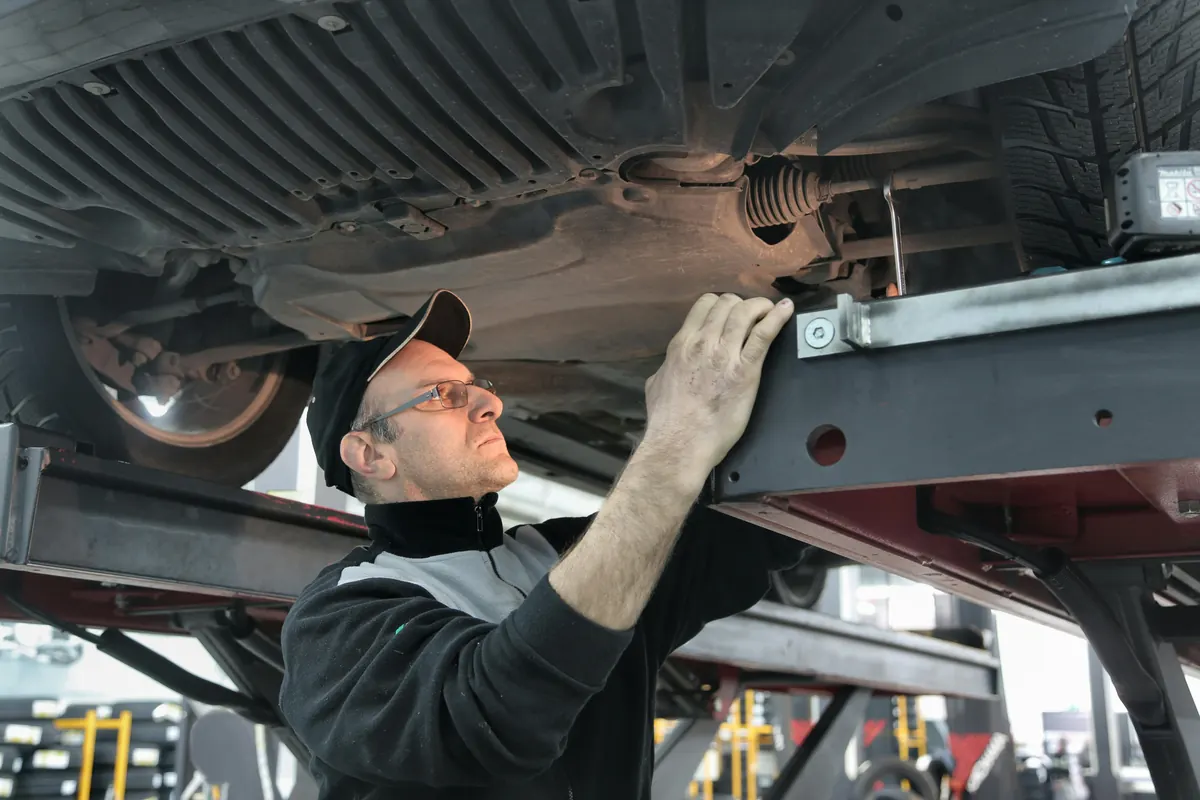
The DVA test centres all use inspection pits rather than the ramp-based or vehicle lifts more commonly found in private GB garages. DVA testers conduct the underfloor inspection from a pit beneath the vehicle, which gives them a different angle and often a more thorough view of the underside than a ramp inspection provides. The full length of the floor pan, chassis rails, sill boxes, and suspension mounting points can be examined from below in a systematic way. This pit-based inspection approach is one reason why structural corrosion failures are identified at a higher rate at DVA centres than at some private GB garages where ramp access can leave some underfloor areas difficult to examine.
The DVA tester will probe suspected corrosion areas using a corrosion assessment tool to determine whether metal has thinned to the point of structural weakness. In NI, where the combination of salt-laden coastal air, high rainfall, and older rural vehicle fleets creates more favourable conditions for underfloor rust, testers are alert to corrosion in specific vulnerable areas: the sill ends near jacking points, the floor pan around seat belt anchorage points, the rear suspension trailing arm mounting brackets, and the front subframe mounting points. Any corrosion that affects the structural integrity of these load-bearing areas will be classified as a Major or Dangerous defect.
Lighting Standards Checked at DVA Centres
DVA testers use beam-setting equipment to check headlight alignment. Both the horizontal aim and vertical aim of each headlamp are checked, with acceptable tolerances differing between dipped beam and main beam, and between vehicles with different headlamp heights. A headlamp that is too high will dazzle oncoming drivers and fails as a Major defect. A headlamp that is too low reduces the driver's forward visibility and also fails. The equipment used at DVA centres is calibrated to the same standards as the equipment used in GB, but the government-operated setting means calibration records are maintained more rigorously than at some private garages where equipment servicing may be less regular.
Daytime running lights (DRLs) on newer vehicles are also checked for correct operation and for whether they automatically switch off when full headlights are engaged, as required by the vehicle's specification. Adaptive headlights with electronically controlled aim adjustment are checked to confirm the self-levelling system is operational. These more modern lighting checks were introduced with the 2018 MOT reform and apply equally in NI and GB.
Emissions Testing for Older Vehicles in NI
Emissions testing for petrol vehicles at DVA centres uses the same idle CO and HC measurement method as GB, with the same pass thresholds based on vehicle manufacture date and catalyst fitment. For a post-1997 petrol vehicle with a three-way catalyst, the CO limit at idle is 0.3 percent and at fast idle the HC limit is 200 parts per million (ppm). Pre-catalyst vehicles face more lenient limits but are increasingly rare.
For diesel vehicles, the DVA uses a free-acceleration smoke opacity test. The vehicle's engine is revved sharply from idle to maximum speed several times and the opacity of the exhaust smoke is measured using a smoke meter probe inserted in the exhaust pipe. Vehicles registered after 2008 must achieve a smoke opacity reading of no more than 1.5 m-1. Older diesels face a limit of 2.5 m-1 or 3.0 m-1 depending on age. In NI, where the older average vehicle age means a higher proportion of pre-2008 diesels remain on the road than in some GB urban areas, emissions testing of older vehicles is a routine part of many tests.
One area where the DVA test does not currently differ from GB is in the testing of petrol particulate filters (PPFs) fitted to newer direct-injection petrol engines. Both the DVA and DVSA have indicated that visual PPF checks will be incorporated into the standard test procedure, but the timeline for formal introduction has shifted. Check the current DVA guidance on nidirect.gov.uk for the latest position on this.
Cross-Border Vehicles: ROI NCT and NI MOT Compatibility
Northern Ireland shares a land border with the Republic of Ireland, and significant numbers of vehicles cross that border daily for work, family, and commercial purposes. Understanding the relationship between the two jurisdictions' vehicle testing systems is essential for anyone living near the border, anyone buying a car that has spent time in the Republic, or any business running vehicles on both sides of the border.
Republic of Ireland NCT and Northern Ireland MOT: Are They Equivalent?
The Republic of Ireland's vehicle testing system is the National Car Test (NCT), administered by the National Car Testing Service (NCTS). The NCT was introduced in 2000 and covers private cars, motorcycles, and light commercial vehicles. Like the NI MOT, it tests roadworthiness at regular intervals. However, a valid ROI NCT certificate is not accepted as an alternative to a NI DVA MOT certificate for vehicles registered in Northern Ireland. The two testing regimes are administered by different jurisdictions, and while they test similar vehicle systems, they are legally separate.
If you drive a Northern Ireland-registered vehicle, you need a valid DVA MOT certificate regardless of whether you also hold an NCT certificate from a test conducted in the Republic. Conversely, a Republic-registered vehicle driven in Northern Ireland is required to hold a valid ROI NCT certificate (or whatever equivalent test applies to its vehicle class in Ireland), because the vehicle's roadworthiness obligations travel with its registration jurisdiction. A Garda Síochána inspection of an ROI vehicle does not automatically trigger a DVA certificate requirement, and a PSNI inspection of an NI vehicle does not accept an NCT as a substitute.
ROI Vehicles in Northern Ireland
Republic of Ireland vehicles driven temporarily in NI are not required to hold a DVA MOT. The vehicle's legal roadworthiness obligation is determined by its country of registration, and an ROI-registered vehicle is required to hold a valid NCT (or commercial vehicle equivalent) issued by the NCTS. PSNI officers conducting roadside checks on a vehicle displaying ROI plates (the white plate with blue EU symbol and IRL identifier) will check the vehicle's NCT status through ROI records rather than DVA records. There is no requirement to obtain a DVA test for an ROI vehicle, even one that is driven in NI regularly.
However, if an ROI vehicle is re-registered in Northern Ireland — for example because its owner has permanently relocated to NI — it then becomes subject to DVA testing requirements. The re-registration process through the DVLA assigns the vehicle an NI registration plate and from that point the DVA testing regime applies. A newly re-registered vehicle from ROI will need to undergo a full DVA MOT if it is four or more years old. The previous NCT history is not formally recognised in the DVA system, although DVA testers may refer to the physical NCT certificates as context when assessing the vehicle's service and maintenance background.
NI Vehicles in the Republic of Ireland
A Northern Ireland-registered vehicle driven in the Republic of Ireland is required to hold a valid DVA MOT certificate. Garda Síochána officers conducting roadside checks can access NI registration data through cross-border enforcement cooperation arrangements that have developed since the Belfast Agreement. An NI vehicle without a valid MOT can be stopped and the driver issued with an enforcement notice under Irish road traffic law in addition to any potential NI offence.
Cross-border commercial vehicles are subject to additional checks. Hauliers operating on both sides of the border must ensure their vehicles comply with the testing and operator licensing requirements of both jurisdictions. DVA-certificated commercial vehicles are generally accepted by Irish enforcement authorities for their roadworthiness status, but operator licence conditions may differ between NI and ROI. Fleet managers running cross-border operations should take specific legal advice on their compliance obligations in both jurisdictions.
Re-Registration Costs and Cross-Border Considerations
Moving a vehicle permanently from the Republic of Ireland to Northern Ireland involves paying UK Vehicle Registration Tax (VRT) equivalent and DVLA re-registration fees. As of 2026, the DVLA charges a fee for assigning a new UK registration mark to a previously registered foreign vehicle, plus there may be additional duties depending on the vehicle's value and the date it was first registered. Full details of the re-registration process and applicable fees are available on the DVLA's website at gov.uk/vehicle-registration. Budget for approximately £55 to £80 in DVLA registration fees, plus any applicable duty based on the vehicle's value.
Border trade vehicles — commercial vehicles routinely crossing the NI/ROI border for business purposes — are subject to customs requirements post-Brexit as well as vehicle testing requirements. Since the UK left the EU's customs union, goods crossing the border are technically subject to customs checks, though the practical arrangements under the Windsor Framework affect NI specifically. Fleet operators should consult current HMRC guidance on the Windsor Framework rules for goods movements between NI and ROI, as this continues to evolve.
NI Vehicle History: Accessing DVA Records
Understanding what DVA records show — and what they do not — is important for anyone buying, selling, or investigating the background of a Northern Ireland vehicle. The DVA maintains its own vehicle testing database that is entirely separate from the DVSA database used in Great Britain. The two systems do not share data, do not cross-reference each other automatically, and cannot be queried through a single unified interface.
What the DVA History Shows Versus DVSA History
A DVA MOT history check, conducted through nidirect.gov.uk, shows the following information for each test on record. The test date tells you when each MOT was conducted. The test result (pass or fail) is shown for each test. The mileage recorded at the time of the test is shown, which is one of the most valuable pieces of information for used car buyers because inconsistent mileage figures between consecutive tests can indicate odometer tampering. Each test result also shows any advisory notes recorded by the DVA tester, which indicate items that were not serious enough to cause a failure but that the tester flagged for the driver's attention.
The DVSA history for a GB vehicle shows broadly equivalent information: test dates, results, mileage at each test, and advisory/failure information. The key difference is that the DVSA history is accessible through a well-known and widely used public API that powers dozens of third-party MOT checking tools. The DVA history, by contrast, is accessible primarily through the nidirect.gov.uk interface. Third-party tools that query only the DVSA API will return no data for NI plates, which can mislead buyers into thinking a vehicle has no test history when in fact it has a full DVA record.
NI Registration Plates Explained
Northern Ireland's vehicle registration system has used the three-letter four-number format since the early days of vehicle registration. The format predates the GB system changes of 2001 and 1983 before that. An NI plate consists of three letters followed by a space and four digits: for example, GIL 1234 or AXZ 5678. The letter allocations for NI plates used specific letter combinations that were not used in the old GB county system, which is why letters like I and Z are reliable indicators of NI origin.
The issuing offices for NI plates were the various vehicle registration offices across Northern Ireland, and the first letter of the plate combination typically indicates which office issued it. Belfast registrations often begin with B or E, while other areas have their own initial letters. The letter Z appears frequently in NI plates regardless of area because it was available across multiple NI issuing offices. A plate beginning with the letter I is always from NI (or potentially from the Republic, where I-prefixed plates are also used).
When a Northern Ireland vehicle is re-registered in Great Britain, it receives a new GB format plate. The original NI plate is surrendered and the vehicle's NI DVA test history becomes accessible only under the old NI plate. The new GB plate starts fresh in the DVSA system with no pre-existing MOT history. This is normal and expected, but it means that a provenance check on the new GB plate will show a vehicle with apparently no MOT history prior to a certain date. Keeping the original V5C showing the previous NI registration is important for establishing the vehicle's full history.
DVLANI versus DVLA Records
Vehicle registration in Northern Ireland was historically managed by DVLANI (Driver and Vehicle Licensing Northern Ireland), a separate agency from the DVLA in Swansea. In 2010, the NI vehicle registration function was transferred to the DVLA in Swansea, which now maintains a single central database for all UK-registered vehicles including those in Northern Ireland. This means that for registration, VED, and keeper details, NI vehicles are now fully integrated with the DVLA's central records.
The integration of DVLANI into the DVLA means that a standard DVLA check will correctly identify an NI-registered vehicle's keeper, VED status, and registration details. What it will not show is the vehicle's MOT history, because MOT testing in NI remains with the DVA rather than the DVSA. This distinction — DVLA for registration, DVA for MOT — is the root cause of much of the confusion experienced by people checking NI vehicles through standard online tools.
Learn more about what DVLA records show for any UK vehicle.Common Reasons NI Vehicles Fail MOT
Northern Ireland's MOT failure statistics reflect both the universal causes of vehicle deterioration and some NI-specific factors related to climate, geography, and the age profile of the vehicle fleet. Understanding the most common failure reasons helps owners prepare their vehicles properly before attending a DVA test, potentially saving the cost and inconvenience of a retest.
Weather-Related Corrosion: Higher in NI
Northern Ireland's climate is significantly wetter and more salt-laden than most of England. The province receives some of the highest annual rainfall totals in the UK, with many western areas seeing over 1,200 mm of rain per year. Coastal areas are exposed to salt-laden air from the North Channel and the Atlantic. Roads are gritted heavily during winter. The combination of persistent moisture, road salt, and the older average age of the NI vehicle fleet creates conditions highly favourable to metal corrosion on vehicle undersides.
Structural corrosion is consequently a more significant MOT failure cause in NI than in many parts of England. DVA testers routinely identify serious corrosion on the sills, floor pans, suspension mounting points, and chassis rails of vehicles that are six to ten years old — vehicles that might show only minor surface rust in a drier English climate. For owners of vehicles in this age range, having the underside inspected and treated with a cavity wax or underseal product before the MOT is a worthwhile investment. A specialist vehicle rustproofing treatment applied between tests can significantly reduce the rate of corrosion in NI's climate.
Rural Roads and Suspension Wear
A significant proportion of NI's road network consists of rural B and C roads that carry substantial agricultural traffic and are subject to surface deterioration from heavy vehicles and frost damage. The rougher road surfaces accelerate wear on suspension components — particularly shock absorbers, coil springs, anti-roll bar links, and wheel bearings. Vehicles regularly driven on rural NI roads tend to show suspension wear earlier than urban vehicles covering similar mileages on smoother surfaces.
Shock absorber failure is one of the more common suspension-related failure reasons at DVA centres. A shock absorber that is leaking or has lost its damping effectiveness will cause the vehicle to continue bouncing after hitting a bump, reducing tyre contact with the road and extending braking distances. DVA testers check shock absorbers using both a visual inspection (for oil leaks and physical damage) and a bounce test or roller-plate test. A vehicle that has spent its life on rural NI roads may have shock absorbers that are technically within specification on a new vehicle but that have worn more quickly than expected.
Older Vehicle Fleet Statistics
Northern Ireland has a slightly older average vehicle age than the UK national average. According to DVLA registration data, the average age of a licensed vehicle in NI is approximately eight to nine years, compared to a UK-wide average of around eight years. While the difference is modest in average terms, the distribution matters: NI has a higher proportion of vehicles aged twelve years or more than many parts of England. Older vehicles fail MOT at significantly higher rates than newer vehicles: data from DVSA and DVA test statistics consistently shows that vehicles aged ten or more years have first-time pass rates well below the 60 to 65 percent average.
The most common failure categories across the NI vehicle fleet in recent years, in approximate order of frequency, are as follows. Lighting defects — including blown bulbs, failed indicator units, and headlamp beam misalignment — account for the largest share of failures, typically around 20 to 25 percent of all failure items recorded. Tyre defects including insufficient tread depth and sidewall damage account for a further 15 to 20 percent. Braking system deficiencies — uneven brake performance across an axle, below-minimum efficiency, or seized handbrake mechanisms — account for approximately 10 to 15 percent. Suspension defects, many related to the road surface and climate factors described above, account for around 10 percent. Bodywork and corrosion failures, including the structural corrosion issues discussed above, are proportionally higher in NI than in equivalent GB statistics, accounting for approximately 8 to 12 percent of failure items in older vehicle categories.
- Check all bulbs — front, rear, indicators, number plate light — before your DVA test appointment
- Inspect tyre tread depth at multiple points across the tyre width; the minimum 1.6 mm applies across the central three-quarters
- Test brake performance by applying the footbrake firmly at a safe speed and checking for any pull to one side
- Bounce the front corners of the car: more than one full rebound after releasing indicates worn shock absorbers
- Inspect the underside for rust, particularly around sills, jacking points, and suspension mounts
- Check all suspension bushes and anti-roll bar drop links for cracking, splitting, or excessive movement
- Ensure wipers clear the screen cleanly without smearing; blade replacement is cheap and prevents an advisory
- Test the horn, all seatbelts, and mirror condition before attending
Official Government Resources
The following official UK government sources provide authoritative information relevant to this topic:
Northern Ireland vehicles should be verified via NIDirect rather than the Great Britain DVSA service, as the two databases are maintained independently.
Frequently Asked Questions About NI MOT Testing
Who runs MOT testing in Northern Ireland?
Can I get an MOT at a private garage in Northern Ireland?
At what age does a Northern Ireland vehicle need its first MOT?
Is a Northern Ireland DVA MOT certificate valid in England?
How do I book an MOT in Northern Ireland?
Can I check an NI vehicle's MOT status online?
Why does an NI plate show no MOT history on standard online checkers?
What is the pass rate for NI MOT tests?
Do historic vehicles in Northern Ireland need an MOT?
Does a NI vehicle need a new MOT when moved to Great Britain?
How much does an NI MOT cost in 2026?
Related Checks
MOT History Checker
An MOT history check reveals all past MOT tests for a UK vehicle — including test dates, results, and advisory notes from DVSA records.
MOT and Road Tax Checker
A combined MOT and road tax check lets you verify whether a UK vehicle has both a valid MOT and current VED in a single search.
DVLA MOT Checker
The DVLA holds the central record of all UK registered vehicles. Check registration status, keeper details, and VED alongside MOT data.