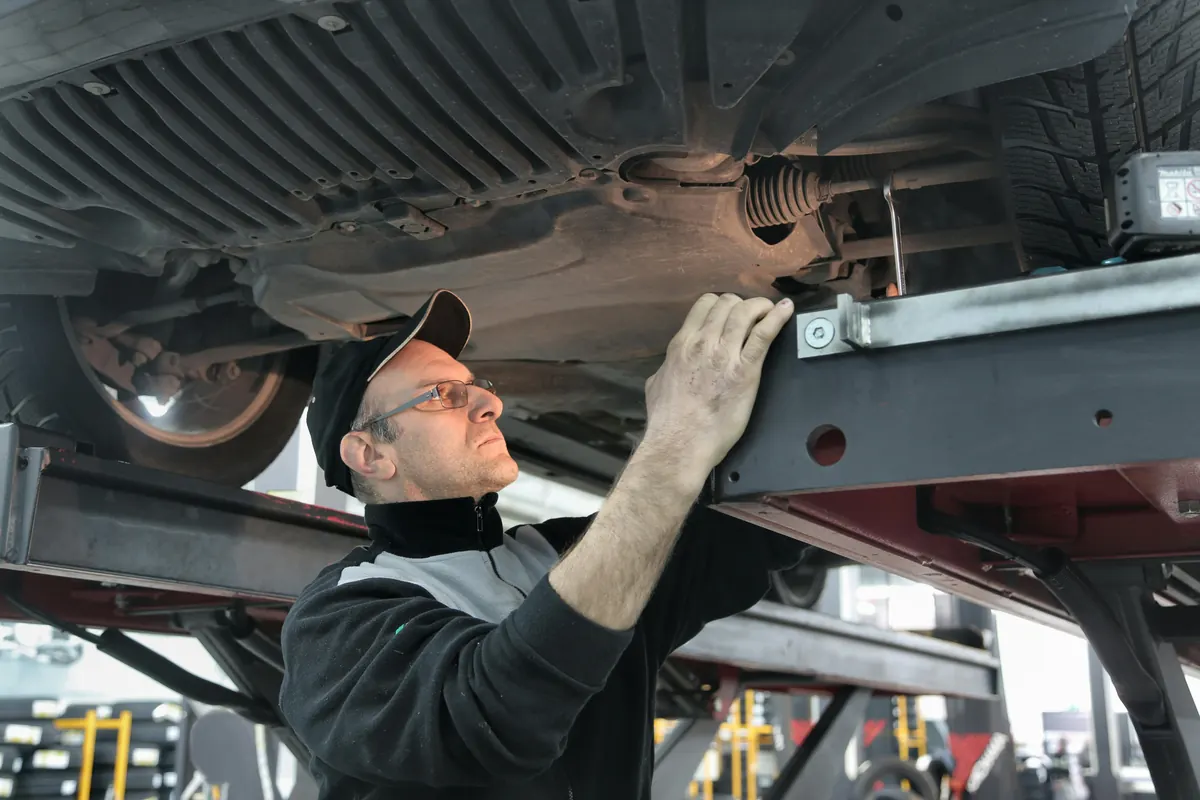
There are over 23,000 DVSA-authorised MOT test centres across the UK — so finding one close to you is rarely a problem. The challenge is picking a good one. This guide shows you how to locate, vet, and book the right garage, and what to do once the test is done.
How to Find a DVSA-Approved Test Centre
The official route is the DVSA's own service at gov.uk/find-nearest-vehicle-tester. Enter your postcode and it returns a list of every approved test station within a set radius, along with contact details and the classes of vehicle they test.
The key word is approved. Any garage can call itself a service centre, but only those with DVSA authorisation can legally issue an MOT certificate. Approved centres display a blue-and-white MOT logo on their signage — if you do not see it, ask before you book.
Comparison booking sites like BookMyGarage, WhoCanFixMyCar, and Halfords autocentres also have postcode-based finders with live pricing. These often show real-time availability and let you book in seconds.
What to Look for When Choosing a Local Garage
Price matters, but it is not everything. The cheapest MOT in your area may be at a garage with poor reviews and a tendency to add spurious failure items. Start with Google reviews and look for patterns — consistent comments about honesty and communication matter more than star count.
Check whether the garage specialises in your vehicle type. A centre that mainly handles commercial vehicles may be less familiar with the specific nuances of sports cars or older classics. Most garages handle standard cars, but it is worth confirming for anything unusual.
Ask if the garage will contact you before proceeding with any repairs. A reputable centre will call with a quote and wait for your approval — not start work and hand you a bill at collection.
Booking Your MOT — Timing and Tips
You can book an MOT up to 28 days before your current certificate expires. If you do this, the new certificate starts from your old expiry date — not the test date. So booking a month early costs you nothing in certificate length.
Morning slots on weekdays tend to be the quickest. The garage is fresh, the ramps are free, and there are no afternoon backlogs. Avoid Fridays if you can — a failure on a Friday with no repair slots available means a weekend without a car.
Many garages now offer a reminder service by email or text. If yours does not, use our MOT checker to see your current expiry date and set your own calendar reminder — three months ahead is ideal.
Classes of MOT Test — What Your Local Centre Can Test
Not every test centre can test every vehicle. DVSA authorisation is granted per vehicle class. Class 4 (standard cars up to 8 seats) and Class 7 (light commercial vehicles up to 3,000 kg) are the most commonly available.
Motorcycles (Class 1 and Class 2) are often tested at dedicated motorcycle centres or specific bays within larger garages. Not every car MOT centre has the equipment for motorbikes — always confirm before booking.
Larger vehicles — minibuses, HGVs, coaches — require specialist Class 5, 6, or 7 authorisation. These are far less common. For these, search gov.uk specifically filtering by vehicle class.
Walk-In vs Booked Appointments
Most test centres prefer booked appointments. Walk-ins are accepted at many garages, but you may wait hours if the ramps are full. Busy urban garages sometimes turn away walk-ins entirely during peak periods.
Booking also tends to be cheaper. Many garages reserve their promotional rates for advance online bookings. Walk-in pricing is often at or near the government maximum.
If you genuinely need a same-day test — perhaps your certificate has just expired and you need the car — call around rather than driving to each garage. Explain the situation and ask if they have a cancellation slot.
What Happens on the Day
Arrive a few minutes early. Bring your V5C logbook if you have it — it is not legally required for the test, but some garages like to confirm details. Your driving licence is also not required.
You do not have to wait at the garage. Most tests take 45 to 60 minutes for a standard car. You can leave and return, or wait in the customer area if there is one.
The tester works through the DVSA checklist systematically. At the end, they issue either a pass certificate (VT20) or a failure notice (VT30). Results are also uploaded to the DVSA database in real time — so you can verify the result yourself using our MOT history checker within minutes of the test completing.
Checking the Result After the Test
Once the tester uploads the result, it appears on the DVSA database. Enter the registration number in our free MOT checker and you will see the test result, the exact expiry date, and any advisory items recorded.
This is useful as a cross-check. If the garage tells you that you passed but the result shows as failed — or if the advisory list they handed you differs from what appears online — query it immediately.
If you ever want to see the full history of every test a vehicle has had — useful when buying a used car — our MOT history checker shows every recorded test since around 2005.
What if You Disagree with the Test Result?
If you believe the tester failed your vehicle incorrectly, you have the right to appeal. You must do this before any repairs are carried out — appeals cannot proceed once the alleged failure items have been fixed.
Contact the DVSA to request an appeal test. An independent DVSA tester will re-examine the vehicle at no charge to you. If they overturn the failure, the original garage may face action.
Appeals are relatively rare. The most common disputes involve borderline advisory items the tester classified as majors. If you genuinely believe the assessment was wrong, do not simply repair and move on — the appeal process exists precisely for this situation.
How Far in Advance Should You Book?
For popular local garages, one to two weeks in advance is sensible. In cities, desirable time slots (early morning, mid-week) can fill up quickly — especially around common renewal months (March and September see peaks in registrations).
If you are flexible on time and garage, last-minute slots sometimes appear via cancellation. Comparison sites sometimes show real-time availability and update frequently.
Whatever you do, do not let your certificate lapse simply because you could not get a convenient slot. Driving without a valid MOT is a legal offence carrying a fine of up to 1,000 pounds. Read our guide on driving without an MOT for the full picture.
MOT Test Centre — Mobile Testing
A small number of DVSA-approved operators offer mobile MOT testing. They bring the equipment to you — useful for commercial fleets or vehicles that cannot easily be moved.
Mobile testing is only available for certain vehicle classes and requires the DVSA to approve the testing location. It is not available for standard private car MOTs at your home address.
For fleet operators with multiple vehicles, dedicated fleet testing arrangements can be agreed directly with DVSA-approved centres — often with preferential pricing for volume bookings.
How to Find a DVSA-Approved MOT Test Station Near You
The DVSA maintains a publicly searchable list of every authorised MOT test station in Great Britain. You can access it at gov.uk/find-nearest-vehicle-tester. The tool asks for a postcode and a vehicle class, then returns a paginated list of stations ordered by distance. Each result shows the station name, address, phone number, and the classes of vehicle it is approved to test. This is the only definitive source — any garage not appearing on this list cannot legally issue an MOT certificate, regardless of what it claims.
Northern Ireland uses a separate, government-run system. MOT tests there are carried out at Driver and Vehicle Agency (DVA) test centres rather than private garages. The DVA operates around 15 test centres across the province, and all bookings are made directly through the DVA online portal at nidirect.gov.uk/motni. If your vehicle is registered in Northern Ireland, our NI MOT checker pulls from the DVA database rather than the DVSA one.
The term authorised examiner (AE) is worth understanding. An AE is the business or individual that holds the DVSA contract to carry out MOT testing. A single AE can operate one or more vehicle testing stations (VTS). When you see a large garage group with multiple branches, the parent company is typically the AE and each branch is a separate VTS. The AE is responsible for the conduct of all testers working under their authorisation — so if something goes wrong at a particular branch, it is the AE who faces DVSA sanctions.
Vehicle class is a critical filter when searching. The DVSA classifies vehicles for MOT purposes as follows:
- Class 1 and 2: Motorcycles and scooters with and without sidecars. Class 1 covers those under 200 cc; Class 2 covers those at 200 cc and above.
- Class 3: Three-wheeled vehicles below 450 kg unladen. Relatively rare — not every centre carries this authorisation.
- Class 4: Cars with up to eight passenger seats. This is by far the most common class and covers the vast majority of private vehicles on UK roads.
- Class 5: Minibuses and passenger vehicles with more than eight seats. These require specialist pits and equipment and are far less widely available.
- Class 6: Light goods vehicles that were first registered before 1 January 1960. Rarely tested at standard garages.
- Class 7: Goods vehicles between 3,000 kg and 3,500 kg design gross weight — Transit-sized vans and similar. Commonly tested at Class 4 stations that hold dual authorisation.
If you drive a van, a motorcycle, or anything other than a standard car, always confirm the vehicle class with the garage before booking. A test station advertising MOT services may only hold Class 4 approval. Turning up with a 3.5-tonne panel van at a Class 4-only station means a wasted journey.
Comparison booking platforms — BookMyGarage, WhoCanFixMyCar, and the Halfords Autocentre booking portal among others — are a convenient alternative to the gov.uk tool. They show real-time availability and pricing, and most automatically filter results to stations that can test your specific vehicle class. They do not, however, show every approved station. Some independent garages do not list on aggregators, which is why the DVSA finder remains worth checking if you want the broadest possible choice.
Tip: When you use the gov.uk finder, the results include a station reference number. If you have any doubt about a garage's approval status — for example, if you found them through a local advert rather than a verified listing — you can cross-reference the reference number directly with the DVSA.
What DVSA Approval Actually Means
DVSA approval is not simply a matter of filling in a form. Before a test station receives authorisation, DVSA inspectors visit the premises to verify that it meets a detailed set of physical and operational standards. Approval is not permanent — stations are subject to ongoing monitoring and can have their authorisation suspended or revoked if standards slip.
The physical requirements are substantial. A standard Class 4 station must have a testing bay of specified minimum dimensions — broadly speaking, long enough and wide enough to accommodate the largest car in that class with room for the tester to work around it. The bay must have adequate lighting, a pit or ramp for underside inspection, a roller brake tester (RBT) for assessing braking efficiency, a headlamp aim tester, and an emissions analyser. Diesel vehicles require an opacimeter to measure particulate emissions; petrol vehicles require a four-gas analyser. All of this equipment must be maintained in calibrated working order and tested at intervals specified by the DVSA.
The people carrying out the tests must also meet specific qualification requirements. Every tester must hold a current MOT tester authorisation — this is not the same as a general mechanic's qualification. To become authorised, a tester must pass the DVSA's MOT tester training course and assessment for each vehicle class they wish to test. The assessment includes both a theory component and a practical component. Testers are also required to complete ongoing continuing professional development (CPD) to keep their authorisation current. A qualified mechanic with no tester authorisation cannot legally carry out an MOT test, even on their own premises.
The AE themselves — the business holding the overall DVSA contract — must demonstrate competence in managing a testing operation. They are responsible for ensuring their testers remain qualified, their equipment is maintained, and their testing practices comply with the DVSA Testing Guide. The AE must also keep detailed records of every test carried out and make those records available to DVSA auditors on request.
DVSA audits are carried out both announced and unannounced. During an audit, an inspector may observe tests in progress, check equipment calibration records, review tester qualifications, and examine testing paperwork. Where deficiencies are found, the DVSA issues a formal notice specifying what must be corrected and by when. Persistent or serious breaches — including issuing passes for vehicles that should have failed — can result in suspension of the AE's authorisation, meaning the station cannot legally test any vehicles until the matter is resolved.
The DVSA also uses statistical analysis to identify anomalies. A station with an unusually low failure rate, for example, may be flagged for closer scrutiny. Similarly, a cluster of complaints about a particular station — submitted via the DVSA's feedback mechanism — will typically trigger an audit or inspection visit.
What this means in practice: When you use a DVSA-approved test centre, you have a reasonable assurance that the equipment is calibrated, the tester is qualified, and the test follows a standardised process. That assurance does not exist at an unapproved premises, however competent the mechanics working there may be.
It is worth noting that DVSA approval relates solely to the MOT testing function. It says nothing about the quality of repair work the garage carries out. A station can hold DVSA approval while being mediocre at servicing. Always assess the repair side of any garage separately, using reviews and recommendations, before deciding whether to let them fix anything flagged at the test.
Independent vs Franchise vs Dealer MOT Centres
The UK's MOT testing landscape is broadly divided into three types of business: independent garages, franchise chains, and main dealerships. Each has genuine advantages and genuine drawbacks. The right choice depends on what you value most — cost, convenience, impartiality, or specialist knowledge.
Independent Garages
Independent garages are privately owned businesses that are not affiliated with any national chain or vehicle manufacturer. They range from sole-trader operations run out of a single bay to well-established local businesses with five or six ramps and a full complement of staff. Most of the UK's 23,000-plus MOT test stations fall into this category.
The main advantages of an independent are price and impartiality. Because they have lower overheads than franchises and no corporate pricing structure to adhere to, independents are more likely to offer tests significantly below the government maximum of £54.85. It is common to find reputable independents charging £30 to £40 for a Class 4 car test. They also have less incentive to generate repair revenue — a criticism sometimes levelled at dealerships — since they are typically not tied to any particular parts supplier or manufacturer warranty programme.
The main disadvantage is variability. There is no independent guarantee that a small single-man garage will match the customer-service standards of a well-run franchise. Reviews matter enormously here. A long-established independent with hundreds of positive local reviews is likely to be more trustworthy than a newer operation with little feedback.
Franchise Chains
Franchise MOT chains — Kwik Fit, Halfords Autocentres, ATS Euromaster, and similar — operate standardised pricing, booking systems, and customer-facing processes across all their branches. This consistency is their core selling point. You know broadly what to expect regardless of which branch you visit.
Pricing at franchise centres tends to sit in the middle ground — typically lower than main dealerships but higher than competitive independents. Many franchise centres offer promotional rates through their own websites or via comparison aggregators, sometimes as low as £25 to £35. These promotional rates are usually online-only and require advance booking.
The convenience factor is significant. Franchise chains often have online booking systems that are easier to use than ringing a small independent, and they may offer longer opening hours including Saturdays. For a straightforward Class 4 car test, a well-reviewed franchise branch is a perfectly reasonable choice.
Main Dealerships
Main dealerships — Ford, Volkswagen, BMW, Toyota centres, and so on — hold DVSA authorisation and can carry out MOT tests as part of their service offering. For newer vehicles still under manufacturer warranty, using a main dealer for the MOT can be administratively convenient, since it can be combined with a scheduled service.
However, dealerships are typically the most expensive option. MOT fees at a dealer often sit at or close to the government maximum, and the workshop labour rates for any consequential repairs are substantially higher than at an independent or franchise. The DVSA authorises the test function separately from everything else, so there is no quality advantage in using a dealer over any other approved centre for the test itself.
Conflict of interest at dealerships: A dealership's service department generates significant revenue from repair work. While the vast majority of testers operate with complete integrity, it is worth being aware that a dealer who fails your vehicle and then quotes for the repair is in a position where commercial incentive and professional impartiality can come into tension. This is not unique to dealers — it applies to any garage that both tests and repairs — but the higher repair margins at a dealership make it more pronounced. If you receive a failure at any garage and the repair quote seems high, get a second opinion from a separate business before committing.
For vehicles still under manufacturer warranty, check whether your warranty requires servicing and MOT work to be carried out at an approved dealer. Some warranties do; most modern ones do not, as long as the work is carried out by a qualified mechanic. If your warranty does not mandate dealer use, there is no technical reason to pay dealer rates for an MOT.
In summary: for most drivers with standard cars, a well-reviewed local independent or a reputable franchise chain offers the best combination of price and reliability. Dealerships make most sense when the test is combined with a manufacturer-schedule service during the warranty period.
Online MOT Booking: Tips to Get the Best Deal
The shift to online MOT booking over the past decade has been substantial. The majority of test centres now accept online bookings, and a significant proportion of drivers book via a comparison aggregator rather than directly with a garage. This has driven genuine price competition — promotional rates available online are often 30 to 50 per cent below the government maximum, which benefits anyone willing to spend ten minutes comparing options.
Using Booking Aggregators
The main aggregators — BookMyGarage, WhoCanFixMyCar, and Motorway (for MOT booking specifically) — work in a similar way to flight or hotel comparison sites. You enter your registration number and postcode, and the platform returns a list of available test stations with pricing and available slots shown in real time. Most also show customer review scores sourced from verified post-test feedback, which is more reliable than generic Google reviews since it relates specifically to MOT experience.
When using an aggregator, be aware that not all approved test stations list on every platform. A garage you find on BookMyGarage may not appear on WhoCanFixMyCar and vice versa. Running a search on two or three platforms takes only a few minutes and can surface meaningfully cheaper options.
Timing Your Booking for the Best Price
Promotional pricing at test centres tends to follow supply and demand. Slots during peak times — Monday and Friday mornings, and the days surrounding school half-terms when many people use the time off to catch up on admin — are less likely to attract discounts. Mid-week slots on Tuesday, Wednesday, and Thursday are typically when promotional rates appear, particularly for the first appointment of the day (usually 8 or 8:30 am) and for lunchtime slots that garages find harder to fill.
Booking two to three weeks in advance generally yields the best combination of price and slot choice. Very last-minute bookings — within 24 to 48 hours — can sometimes surface cancellation slots at promotional prices, but availability is unpredictable and this approach is risky if your certificate is close to expiry.
What to Look for in Online Reviews
Star ratings give a quick signal, but the content of reviews is more informative. Look specifically for comments about transparency — did the garage communicate clearly about any issues found? Did they contact the customer before starting repair work? Were the advisory items explained properly? A garage that consistently scores well on these points is likely to be more trustworthy than one with a high overall score driven by speed and convenience comments.
Be cautious of review profiles that are either very sparse (fewer than 20 reviews) or implausibly uniform (dozens of five-star reviews with near-identical wording). Both patterns can indicate unreliable review data. For a garage you have not used before, a minimum of 50 verified reviews with a mix of four and five stars and some genuine critical responses is a healthier signal than 200 perfect scores.
Price cap reminder: No DVSA-approved test station can charge more than £54.85 for a Class 4 car MOT (the 2026 government maximum). If you are quoted more than this for the test itself — not for any repairs — the garage is in breach of the fee cap. You can report this to the DVSA. For a full breakdown of MOT costs by vehicle class, see our MOT cost guide.
One final tip: always check whether the promotional price includes a free retest if the vehicle fails. Most test stations offer a free partial retest within a set period (usually 10 working days) if the vehicle is repaired by them. Some offer a free retest even if you have the repairs done elsewhere. This is worth confirming before you book, as it affects the total cost if the vehicle has a borderline issue.
Mobile MOT Services: What They Can and Cannot Do
Mobile MOT testing — where a DVSA-approved tester brings the equipment to your location rather than you bringing the vehicle to a fixed station — is a genuine service, but it operates under significant constraints that are not always made clear in advertising. Understanding those constraints before you book is essential.
Which Vehicles Qualify
The DVSA permits mobile testing for certain classes of vehicle in specific circumstances. In practice, mobile testing is primarily used for:
- Class 4 and Class 7 vehicles belonging to fleet operators where the AE has been granted specific approval to test at a fleet's premises. This is not a service available to individual private car owners.
- Vehicles that are physically difficult or commercially impractical to move — for example, a trailer, a large piece of plant equipment, or a vehicle that has broken down but whose owner needs to establish its test status before arranging repairs.
- Agricultural and specialist vehicles in certain circumstances where the nature of the vehicle makes transport to a fixed station impractical.
What Mobile Testing Cannot Do
The single most important point: a DVSA-approved mobile tester cannot legally test a standard private car at the owner's home address as a convenience service. If you see a business advertising "MOT at your door" for regular private cars, you should verify its DVSA authorisation very carefully before proceeding. The DVSA requires any location used for mobile testing to be pre-approved — it cannot simply be a driveway or a car park.
Mobile testing also requires the testing equipment to be physically present — roller brake tester, emissions analyser, headlamp tester, and so on. Portable versions of this equipment exist, but they must still meet DVSA calibration standards. An operator who claims to carry out a full MOT using only visual inspection and a handheld device is not providing a legitimate MOT test.
When Mobile Testing Makes Sense
For fleet operators managing ten or more vehicles at a single site, a mobile testing arrangement negotiated with an approved AE can be genuinely cost-effective and time-efficient. Instead of taking vehicles off the road to travel to a test station, the station comes to you. DVSA approval for a specific testing location (such as a fleet depot) can be applied for by the AE, and once granted, regular testing can be scheduled on-site.
If you manage a fleet and this arrangement interests you, the starting point is to contact a local AE that already holds mobile testing approval. Not all AEs offer this service, but those that do will be familiar with the DVSA approval process for new testing locations.
Beware of unlicensed "mobile MOT" services: There have been documented cases of operators issuing what appear to be MOT certificates for tests carried out without DVSA authorisation. A fraudulent certificate provides no legal protection — the driver is still committing an offence by driving without a valid MOT. Always verify the AE number of any mobile tester before proceeding, and cross-check it on the gov.uk approved station finder.
MOT Test Centre Complaints: Your Rights
Most MOT tests pass without dispute. But if you believe a test result is wrong — either a failure you consider unjustified or a pass on a vehicle you believe had a genuine defect — you have formal rights. Understanding the process before you need it is more useful than discovering it under pressure.
Appealing an MOT Failure Result
The formal mechanism for challenging an MOT failure is an appeal test carried out by an independent DVSA tester. The critical rule is: you must lodge the appeal before any repairs are carried out. Once the failure items have been fixed, it becomes impossible to verify whether the original assessment was correct, so the appeal process cannot proceed.
To request an appeal test, contact the DVSA directly. The process is:
- Do not allow the garage to carry out any repairs on the items listed as failures.
- Contact the DVSA Customer Services centre and request an appeal. The DVSA target response time for arranging an appeal test is typically within two working days.
- A DVSA-nominated tester — not connected to the original station — will re-examine the vehicle against the same criteria.
- If the appeal upholds your challenge (i.e., the failure items are found to be acceptable), you receive a pass certificate and the original garage is notified. The DVSA may take further action against the garage if the original failure is found to be unjustified.
- If the appeal confirms the failure, you are responsible for the cost of the appeal test. The fee for a Class 4 appeal test is set by the DVSA and is in the region of £55 to £65.
Grounds for Appeal
Valid grounds for appeal include: an item being categorised as a major defect when you believe it meets the acceptable standard; an item being assessed using incorrect criteria for your vehicle type; or procedural failures in how the test was conducted. Appeals based purely on cost — "I cannot afford to fix it" — are not valid grounds. The appeal examines only whether the original assessment was technically correct.
Complaints About Garage Conduct
If your complaint is not about the test result itself but about the conduct of the garage — for example, a tester who was rude, a garage that started repair work without your consent, or a station that charged more than the government maximum fee — the complaint route is different. You can submit a complaint directly to the DVSA via their online feedback system. The DVSA can investigate and, where appropriate, take action against the AE's authorisation.
For commercial disputes — such as a garage that charged you for repairs you did not authorise — the appropriate route is the Citizens Advice consumer helpline or, if the amount is significant, a small claims court application. The DVSA's remit is the testing function specifically; it does not adjudicate on general commercial disputes between customers and garages.
Keep your paperwork: Whether you are appealing a result or pursuing a complaint, keep copies of your VT20 or VT30 certificate, any repair quotes you received, and any written communications with the garage. These are your primary evidence. You can also use our MOT history checker to retrieve the official DVSA record of the test result, which provides an independent reference point independent of any documents the garage may have issued.
The DVSA publishes annual data on the outcomes of appeal tests. Historically, around 20 to 30 per cent of appeal tests result in the original failure being overturned — a figure that indicates the appeal process is a legitimate safeguard rather than a formality. If you have a genuine belief that a failure assessment was wrong, it is worth pursuing.
Official Government Resources
The following official UK government sources provide authoritative information relevant to this topic:
The official DVSA MOT station finder lists all authorised test centres with their contact details and any complaints recorded against them.
Frequently Asked Questions
How do I find a DVSA-approved MOT test centre near me?
Use the official finder at gov.uk/find-nearest-vehicle-tester. Enter your postcode and filter by vehicle class. Comparison booking sites like BookMyGarage also list approved centres with live pricing.
Do all MOT centres charge the same?
No. The government sets a maximum fee (54.85 pounds for cars in 2026) but garages can charge less. Prices vary — always compare before booking, especially online.
Can I get an MOT without booking?
Many centres accept walk-ins but appointments are recommended. Walk-ins may wait hours during busy periods, and promotional rates are usually only available for advance online bookings.
What does the DVSA MOT logo look like?
It is a blue-and-white logo with the letters MOT and the three-pointed arrow symbol. Approved garages must display it on their premises. If you do not see it, confirm DVSA approval before handing over your car.
Can I check my MOT result online after the test?
Yes. Results appear on the DVSA database in real time. Enter your registration in our free MOT checker and the result, expiry date, and any advisory items will appear within minutes of the test completing.
What if I cannot get a local appointment before my MOT expires?
You are legally obliged to renew on time. If your local garages are fully booked, widen your search area or try comparison booking sites for cancellation slots. Driving with an expired MOT risks a fine of up to 1,000 pounds.
Does the DVSA publish a list of all approved test centres?
Yes, via gov.uk/find-nearest-vehicle-tester. The list is comprehensive and updated in real time as new centres are approved or have their authorisation revoked.
How long does an MOT take at a test centre?
Around 45 to 60 minutes for a standard car. Complex vehicles or those with obvious issues may take longer. You do not need to wait — most people drop the car off and collect it once the result is ready.
Planning a Car Purchase?
Before visiting any test centre, use our free tool to check the vehicle's current MOT status and any outstanding advisories — it takes under a minute and may save you an unnecessary trip or an unexpected retest fee.
MOT Check vs HPI — Full ComparisonRelated MOT Guides
What Is an MOT Test? Complete UK Guide (2026)
An MOT is an annual safety inspection required for all UK vehicles over three years old. It checks…
How Long Does an MOT Last? Certificate Duration Explained
An MOT certificate lasts exactly 12 months from the test date. You can renew up to one calendar…
Top 10 MOT Failure Reasons in the UK (2026 Data)
The most common MOT failure reasons are lighting faults (around 18% of failures), followed by…